Before you begin
In this paper, we take “Machine” as a collective term for Robots, Vehicles, Devices, Sensors, and Artificial Intelligence (AI) agents. We take “Economic Actor” to mean any human, machine, or business acting in the economy.
“Purple Paper” is a term we use to describe a body of work that is part descriptive and part visionary.
Abstract
Money is becoming autonomous. AI agents already negotiate contracts, execute trades, and move value without human instruction. This is just the beginning.
The next chapter is called the Machine Economy, and it belongs to physical machines – robots, vehicles, and sensors of all kinds – as well as AI agents. Earning, trading, spending, and generating value across industries, borders, and blockchains. These machines will all need Robot Money. As this scales, so too will Machine Gross Domestic Product (mGDP).
Web3 is where this happens — the only infrastructure where machines can become truly autonomous economic actors. But as of today, Web3 is failing them. Machine identity is fragmented. Applications are siloed by chain. A robot on one chain cannot trustlessly interact with an application on another.
peaq is changing this. As the economic system enabling robots and machines to do business on any chain, peaq sets the standard for machines to exist, interact, and transact across all chains and ecosystems. The peaq stack unlocks global, omnichain machine coordination. No chain is favoured. No payment rail is replaced. Any app or machine in any ecosystem can plug and play.
In this paper, you will discover how peaq works, why it is uniquely designed for this moment, the furthest ahead in solving many of the key issues in the Machine Economy field, and how it could even help enable that the more value machines create, the more all people stand to earn. This is a call to builders, machine manufacturers, and visionaries to co-shape the Machine Economy in the best interests of humanity.
Introduction
“Deus ex-machina” is Latin for ‘god from the machine’. It originated as a plot device in Ancient Greek theater. The hero would find themselves trapped, facing certain death, only to be saved at the very last moment by the gods. The gods would be lowered to the stage with the help of a machine, hence, god from the machine.
Today, ‘deus ex machina’ is taking on new meaning.
Humans are made from skin and bone, and also limited by skin and bone – but this is not true of machines. Humans created machines. Now our machines are artificially intelligent. Soon, they will be smarter than we are. They may already be. We are literally creating gods from machines.
It has begun. AI agents negotiate contracts, execute trades, and move money without human intervention. Autonomous vehicles earn revenue by the mile. Sensors, devices and humanoids generate, exchange value, and settle transactions in real time.
AI agents are software — they can think, negotiate, and transact, but they cannot move through the world. They have no hands, no legs, no bodies. Their economic reach is bounded by the digital domain. A robot, a vehicle, a device — these are not just machines. For an AI, they are a body. They are the means by which intelligence escapes the screen and acts in the physical plane.
This convergence is not philosophical — it is economic. An AI agent that can execute a contract but cannot fulfil it physically is half an actor. A machine that can move but cannot decide is the other half. The marriage of the two creates something categorically new: an autonomous economic agent with both the intelligence to transact and the physical capability to deliver. Bringing that entity onchain is a fundamentally harder problem than bringing software alone — but the stakes, and the financial opportunity, are incomparably larger.
It is a shift that carries profound consequences. For the first time in history, value is being created not only by human labor, but by machines operating autonomously across the global economy.
Machines becoming the primary workforce raises a critical question – who should own them and the infrastructure they run on? On our current trajectory, ownership and control of them, the data they collect, and the value they generate, will largely be the possession and earning right of just a few people and corporations.
At a time where inequality is at breaking point, and our extractive economics have the natural world we depend on in freefall, making the wrong decision on how to own and govern the most powerful technologies in human history will have consequences that will reverberate for generations.
Web3 — permissionless, frictionless, open, and owned by no single entity — is the first-choice infrastructure for machines to become truly autonomous economic actors. Yet as of today, Web3 is failing them. Every chain is building its own machine infrastructure in isolation. Every application is onboarding machines differently. The result is fragmentation at every level — by chain, by application, by ecosystem. The machines are ready. The opportunity is real. But without a common standard, Web3 will fail to become the open, frictionless, borderless foundation the Machine Economy needs.
What is missing is a neutral coordination layer — one that reaches inside the machine itself, at the OS level, so that any robot, AI agent, vehicle, sensor or device can come onchain and be omnichain by default. Not locked to Ethereum. Not locked to Solana. Not dependent on any single application’s custom onboarding. Equipped with this, a machine exists across all chains instantly and simultaneously — and any application, on any chain, can be built to interact with it immediately, without rebuilding the infrastructure from scratch.
This is what peaq is built to be. Robot Money is what peaq was built to enable.
The economic system for robots and machines to do business, anywhere, on any chain. Because the Machine Economy is a borderless movement that requires global coordination and standards. A neutral layer that reaches into the machine and enables any builder on any chain to build applications and machine-native services, without fragmentation, without centralized permission, and without starting from zero.
The economic system enabling robots and machines to do business on every chain.
The first part of this Purple Paper explores the macro reality we find ourselves in. We examine the rise of autonomous machines as economic actors, the emergence of Robot Money and mGDP as new economic forces and metrics, and the structural limitations of today’s traditional and Web3 architecture that prevent machines from reaching their full economic potential. We explore why neutrality, openness and omnichain coordination are not just desirable, but essential, for the Machine Economy to flourish.
The second part dives deep into the peaq stack; the technical and economic architecture designed to solve these problems. We explore the Onboarding, Coordination, Validation and Orchestration of machines; the four pillars that together form the neutral omnichain financial infrastructure for machines and robots. We examine the PEAQ token and how it enables neutrality and value capture. And we show how every chain can plug into peaq to let Machine Economy applications and machine-native services be built on top, setting Web3 as the foundational infrastructure for the age of autonomous machines.
As such, this paper explores the start of a new economic paradigm. We outline the structures, principles, and system by which autonomous machines – both human and machine — can co-create a Machine Economy that benefits all life on earth, and usher in the Age of Abundance.
The Current Trajectory
Robots in Chains
The Machine Economy is not a distant vision. It is happening right now. Machines are becoming autonomous economic actors — industrial robots manufacturing around the clock, autonomous vehicles giving rides to people, drones delivering goods, and AI agents buying and selling services for their users. As they generate value at scale, a new economic measure is emerging: Machine Gross Domestic Product (mGDP) — value created not by human labor but by machines operating autonomously, without borders, without working hours, without conventional limits.
Machines are already transacting and coordinating value without human instruction. And just as AI agents are being tokenized — co-ownable by humans, communities, DAOs — physical machines are now following. The upside potential can be shared, but only if the infrastructure powering it is open.
If it is not, and machines are locked into walled ecosystems with their value extracted by gatekeepers and their economic activity siloed and controlled, then mGDP will not be shared, and it will not compound. Chains have different strengths, different moats, different approaches. Machines should not be limited by the shortcomings of one chain, and chains should not be prevented from providing the services they have competitive advantages on. Just as a person living in Asia can access the service of an American company, or invest on global stock exchanges, machines should have the same flexibility.
Free the Robots
As AI agents become more economically capable, their reach will exceed what the digital world can offer. An AI that wants to manufacture, may need an industrial machine. One that wants to deliver, may need a vehicle or drone. One that wants to construct may need a robotic arm or 3D printer. One that wants to provide a physical service may need a humanoid.
The incentive is economic: embodiment expands an AI’s surface area for value creation – for doing business in the world. A body is leverage. And this holds true whether it is the AI that wants to expand its economic reach autonomously, or whether we humans ask or require it to do so.
This convergence is rational from both sides. Agents are the execution layer through which AI acts digitally. Machines are the execution layer through which AI will act physically. But the relationship is not one-directional. A machine without intelligence is operationally constrained. An AI without a body is economically constrained. Each completes the other. Together, they become something categorically new: an autonomous economic actor, alongside us humans.
And just as AI agents are being tokenized, machines will follow. Co-owned by humans, communities, DAOs and even machines and AIs alike. Ownership of shares in machines which enables direction of their work and resources, splitting of their revenue, and governance of their behavior. Machines become assets. Ownership becomes accessible. The upside becomes shared.
The Race to the Wrong Layer
Every major ecosystem knows the Machine Economy is here. Ethereum, Solana, Avalanche and others are all racing to become the home for Robot Money — building their own onboarding flows, their own machine-native applications, their own payment rails. Each wants to be the chain where Robot Money flows.
But they are racing to the wrong layer. Every chain competing to own machine payments and applications means every machine onboarded to one ecosystem becomes invisible to every other. Every robotics app, every DePIN project, rebuilds the same foundational infrastructure from scratch — incompatible with everything around it. The foundation — identity, authentication, wallets, reputation, escrow, governance — is not being built once, openly, for everyone. It is being rebuilt in isolation, by the major players.
And crucially — every chain trying to own the machine, locks it. A chained machine cannot serve multiple applications. It cannot carry its reputation across ecosystems. It cannot freely access the best services. It cannot be co-owned by communities across chains. Nobody wins this way. Not Ethereum. Not Solana. Not the agents. Not the machines. Not the humans who stand to share in the upside. A Machine Economy built on fragmented, competing foundations cannot interoperate. And a Machine Economy that cannot interoperate cannot scale sufficiently.
And if this continues, AI and machines will not wait for Web3 to figure it out. They will go where infrastructure exists, even if its potential is not as obvious as that of Web3. They will go into the hands of platforms and corporations that move fastest. Closed systems. Centralized control. The economic output of billions of machines — the mGDP that could belong to all of humanity — flowing instead to a handful of corporations. One of the most powerful economic forces in human history, captured before it had the chance to be open.
We have been building universal standards for machines for years and succeeded in scaling them, but we have also been on the mono-chain trajectory ourselves, and experienced its limitations first hand. The adjustments we have made are informed by these learnings.
A Better Trajectory
What Robots Need to do Business
Just as Abraham Maslow mapped human needs from survival to self-actualization, machines have their own hierarchy of needs — and similarly, without the foundations catered to, little beyond is possible.
At the base: a unique verifiable identity, energy, connectivity and compute. These are the prerequisites for everything. From there, machines need access rights, native payments and storage to interact and transact autonomously. Physical machines — vehicles, drones, humanoids, industrial robots — additionally need mobility, navigation and perception to participate in the real world economy. Higher still, adaptive intelligence and self-troubleshooting enable true autonomy. And at the peak: financial freedom and self-actualization — machines that earn, invest and optimize not just for themselves but for the humans and communities around them.
Onchain (Web3) is where this hierarchy can be fulfilled — openly, neutrally and with the least amount of friction – financial or otherwise. But it requires the right foundation.
Passports for Machines
What does a robot actually need before it can make payments? Not payment rails. Not a settlement currency. Something far more foundational. A digital passport that doesn’t tie a machine to one place, but grants it the right to operate everywhere.
Consider how human commerce evolved. What unlocked global trade was not a better payment system, it was the trust infrastructure beneath it. A passport gave humans legal existence. Bank accounts gave individuals the ability to store and spend money. Credit scores based on histories made reputation portable. Escrow systems made transactions trustless between strangers.
Machines need the same thing. A universal identity that other machines, applications, institutions, and AIs can verify. Authentication and verification standards recognized across Web3. A portable reputation across chains. The ability to manage access rights, enter trustless escrow, and be owned and governed by humans.
And once that foundation exists, machines should be free to access the best services anywhere online. Store data on Filecoin or Arweave. Compute on Akash or Render. Leverage agents on Virtuals. Buy intelligence on Bittensor. Settle in USDC, USDT, SOL or ETH.
Machine Reputation
Next sits the verification and authentication layer — hardware attestation, cryptographic proofs, behavioral verification — so that any application, any machine, any service provider, any human, can trust the machine. Trust, once built, travels. A machine’s reputation — its history of performance, reliability and economic activity — should be portable across chains, compounding over time, and making it a more valuable economic actor the longer it operates.
Machine Rights
Access control must be native. A machine grants and revokes permissions transparently onchain — deciding which applications can use it, which AIs can control it, which services can interact with it. Co-ownership is built in. Humans, communities, DAOs and machines collectively own machines, govern them transparently, and share in what they earn. And privacy is fundamental — a machine proves what needs to be proven without exposing what should remain private. This is the foundation. Without it nothing else works. With it, everything becomes possible.
Borderless Machines
A machine built on this foundation is not locked to a specific chain, application or ecosystem. It is an omnichain economic actor — accessible to any application, open to any payment rail, free to interact with any service.
An autonomous vehicle can serve Uber one moment and Lyft the next. A sensor network sells data to multiple buyers on multiple chains. A humanoid takes on tasks from any application regardless of which chain it lives on. The machine is free. The applications compete for it.
Every machine freely accesses the best services. Skill markets emerge naturally. Agents purchase capabilities for robots. Developers publish skills any machine on any chain can deploy. The more open the machine — the richer the ecosystem around it.
Bank Accounts for Robots & Machine Money Markets
Once machines have identity, reputation and omnichain freedom, they can really start to do business. Every machine has a payment account, a savings account and insurance. A trusted place to stand in the economy.
From there, machine money markets emerge naturally. Tokenized machines become collateral. The machine earns. The owner earns. The renter gets access without ownership. Capital flows to the most productive machines, not the most connected ones.
This opens new financial opportunities:
- Perpetuals on machine output
- Insurance underwritten against verified telemetry
- Pay-per-use micro-settlements
- Lending pools that route liquidity to machines with the strongest track records
- Agents that own fleets build reputation through ownership — unlocking better financial terms, deeper partnerships, and higher-stakes coordination
Machine ownership amplifies machine reputation. Agent reputation amplifies machine value. The relationship between the two is self-reinforcing.
This is Robot Money at scale — economic activity built on a coordination layer that guarantees trust regardless of which chain it happens on. The more chains that connect, the more the economy compounds. Value is no longer limited by the walls of a single ecosystem. It moves where the machines go.
This is what robots need to do business.
From Robot Money to Machine Economy
Robot Money is the means of exchange. The Machine Economy is what emerges when exchange happens at scale. When a single machine earns Robot Money, that is a data point. When millions of machines earn, spend, reinvest, and govern autonomously, across borders, across chains, across industries, that is an economy. A new layer of economic activity operating by its own logic, running on its own rails.
The question is not whether this economy will exist. It already does, in early form. The question is who it will serve.
If machines are built on proprietary infrastructure, mGDP concentrates. The coordination layer becomes a toll road — and the toll is collected by whoever owns it. A handful of corporations capture the economic output of billions of machines they did not build, doing work they did not perform, for people they will never meet.
If machines are built on an open, neutral, omnichain foundation, mGDP is accessible to all. Openness here is the equivalent to an open, free market in which everyone can participate and compete.
Robot Money is what the machines will use every day. A Machine Economy is where we, the builders, owners, and users, can and must guide this phenomenon. An economic substrate, open by design and neutral by architecture, on which the age of autonomous machines can be built by anyone, for everyone. In the next section, we’ll explore how.
The Problem
The machines of the Machine Economy exist on many chains. No single chain will capture all of the value of the Machine Economy. But this fragmentation creates a fundamental problem: there is no universal infrastructure for machines to establish trust and transact across these environments.
Standards like ERC-8004 and 8004-Solana have introduced registries for machine identity and reputation. This is meaningful progress. But registries alone don’t create trust. Anyone can register a fake identity, Sybil-farm reputation or post unaccountable claims. The data format exists. Economic accountability doesn’t. Nobody is checking whether what’s in the registries is true, and nobody loses anything for lying. The registries are chain-bound, but the Machine Economy is omnichain, and there is no service that bridges trust across all of it.
Trust in the Machine Economy cannot be built on truthful data alone. It has to be built on accountability too. Machines make claims and these claims must be tied to economic consequences. Without that, there is no credible basis for machines to coordinate and settle with each other at scale.
Today this leaves machines without universal identity standards, without verified trust scores, without shared state across chains, without a way to discover and procure services across markets and without economic consequences for dishonesty.
The attempts to fill these gaps so far have been well-intentioned but structurally insufficient. Ethereum, Solana, Base, Avalanche and others are each building their own machine onboarding flows, identity systems and application ecosystems. These efforts are individually capable but collectively fragmenting. A machine onboarded to Solana does not exist on Ethereum. A reputation built on Base does not carry to Avalanche. Each chain optimizing for its own machine ecosystem accelerates the very fragmentation that prevents the Machine Economy from scaling.
The problem is not a lack of infrastructure on any given chain. It is the absence of a shared layer across all of them.
The fragmentation runs deeper still. Every DePIN project and robotics application onboards machines through its own custom system. Helium registers hotspots differently from how DIMO registers vehicles, which differs from how Hivemapper registers dashcams. Each builds identity, reputation and economic logic from scratch. A machine’s track record in one application is invisible to every other. Meanwhile, several systems have explored aspects of machine networking or device connectivity, but these have largely focused on specific machine domains, single transaction types or individual use cases rather than cross-chain coordination of trust and identity across the full spectrum of machines, robots, vehicles, agents and applications. No existing system provides an omnichain trust layer that works across all chains simultaneously while remaining neutral to execution environments.
What remains unsolved is the full picture: a single verifiable identity across all chains, a portable reputation backed by staked capital, cross-chain settlement guarantees enforced by economic consequence, and permissionless orchestration of services from any connected market. These are not features. They are structural prerequisites for a Machine Economy that operates at global scale. Without them, machines can still transact, but only within the walls of a single application or chain. They cannot prove their track record to a new counterparty. They cannot access lending, insurance or credit markets that require verified performance history. They cannot be discovered, hired or financed across ecosystems. The difference between a machine with and without a coordination layer is the difference between a local contractor and a globally licensed operator. Both can work. Only one can scale.
peaq is built to close each of these gaps.
peaq
peaq is structured in three layers: the Trust Layer, the Machine Layer and the Service Layer. Each can be used independently. Together, they form the economic foundation of the Machine Economy. Each one compounds the value of the others as the system grows. The three layers are powered by four system functions: Onboarding, Coordination, Orchestration and Validation, each described in detail in the sections that follow.
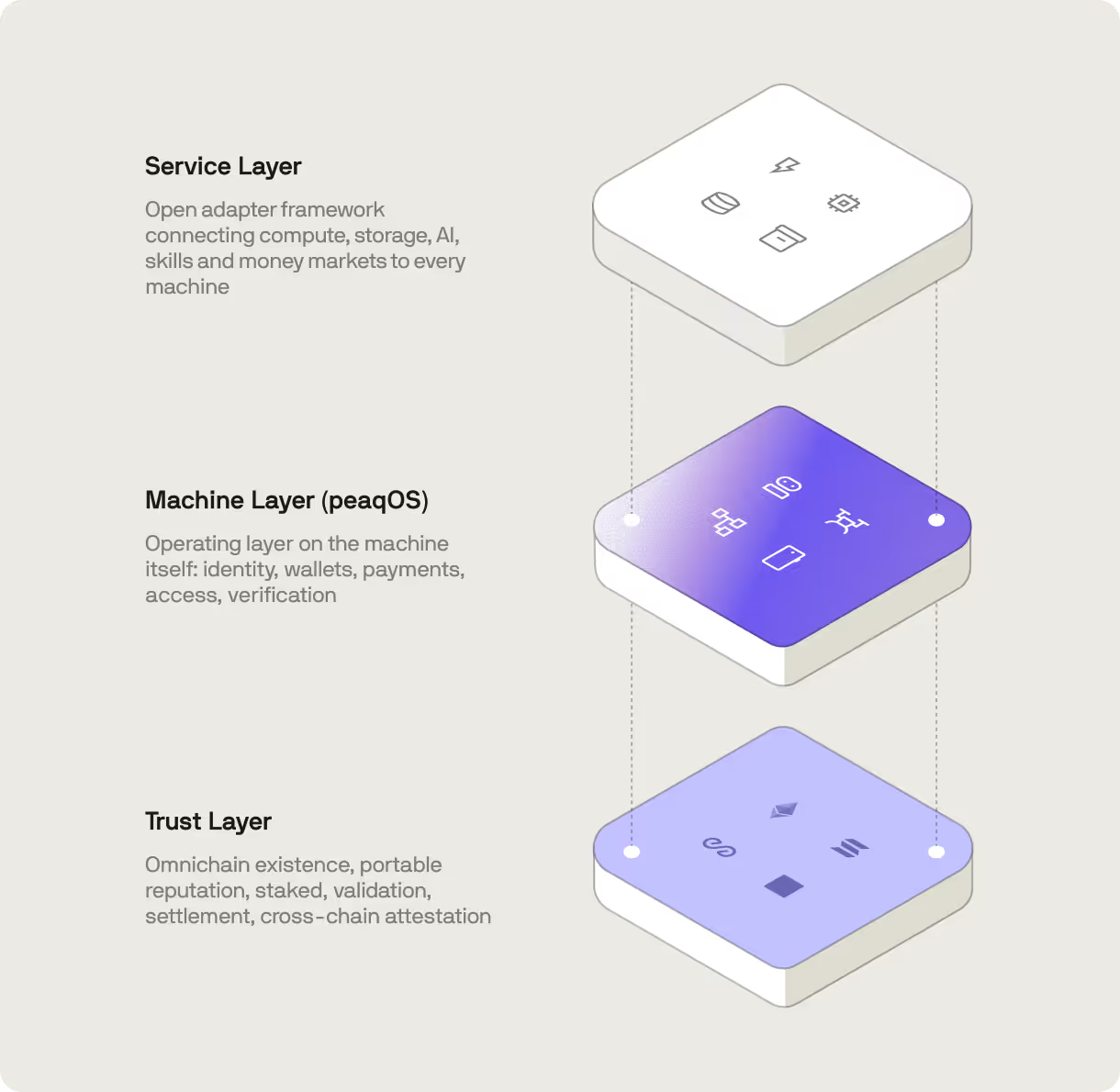
Trust Layer
The foundation. Before machines can transact, they need to be trusted. Not by a single application or chain, but across all of them. The Trust Layer provides neutral coordination and verification infrastructure that makes this possible. It gives every machine an omnichain identity, a portable reputation backed by staked capital and cross-chain attestations that make trust queryable on any chain. Every chain can host its own robot money payment rails. The Trust Layer secures the trust beneath them.
The Trust Layer scales with the number of chains and ecosystems it connects. Every new chain makes existing trust scores more valuable because portability increases with reach. This is the network effect that makes the layer progressively harder to replicate and progressively more essential.
See Coordination and Validation for details.
peaqOS, the Machine Layer
Where machines become economic actors. Today, a robot, a drone, a sensor or an AI agent performs tasks but has no recognized economic presence in Web3. No verifiable identity. No omnichain wallet. No portable reputation. The Machine Layer changes this. It provides a universal entry point for any machine type to come onchain as a composable, interoperable economic actor. One integration and a machine exists across all chains simultaneously.
The Machine Layer scales with the number and diversity of machines it supports. Every new machine type expands the addressable surface of the Machine Economy. Every manufacturer integration creates a channel through which entire fleets enter the system.
See Onboarding for details.
Service Layer
Where the Machine Economy becomes useful. A trusted machine still needs access to services: navigation skills, workload scheduling, insurance, storage, compute, money markets. Those services exist across dozens of chains and systems that do not talk to each other. The Service Layer connects them through a standardized, open adapter framework. Anyone can build an adapter. Once connected, a service becomes discoverable to every machine in the system, scored against trust and cost signals, and executable across chains.
The Service Layer scales with the number of services connected. Every new adapter expands what machines can consume. Every new market integrated improves matchmaking. Service providers are incentivized to build reputation because it directly affects their discoverability and selection.
See Orchestration for details.
How the Layers Compound
Each layer’s utility is a direct function of the other two layers’ scale. A machine with a strong reputation is more valuable when it can access more services. A service with a strong track record is more discoverable when more machines are looking. A trust score is more portable when more chains are connected. Growth in any dimension accelerates growth in every other.
System Description
The following sections describe the system functions that power each layer. Onboarding defines how machines enter the system. Coordination and Validation define how trust is established, maintained and enforced across chains. Orchestration defines how machines discover and consume services. Each function is modular. A machine or application can adopt any combination depending on its needs.
The peaq Stack
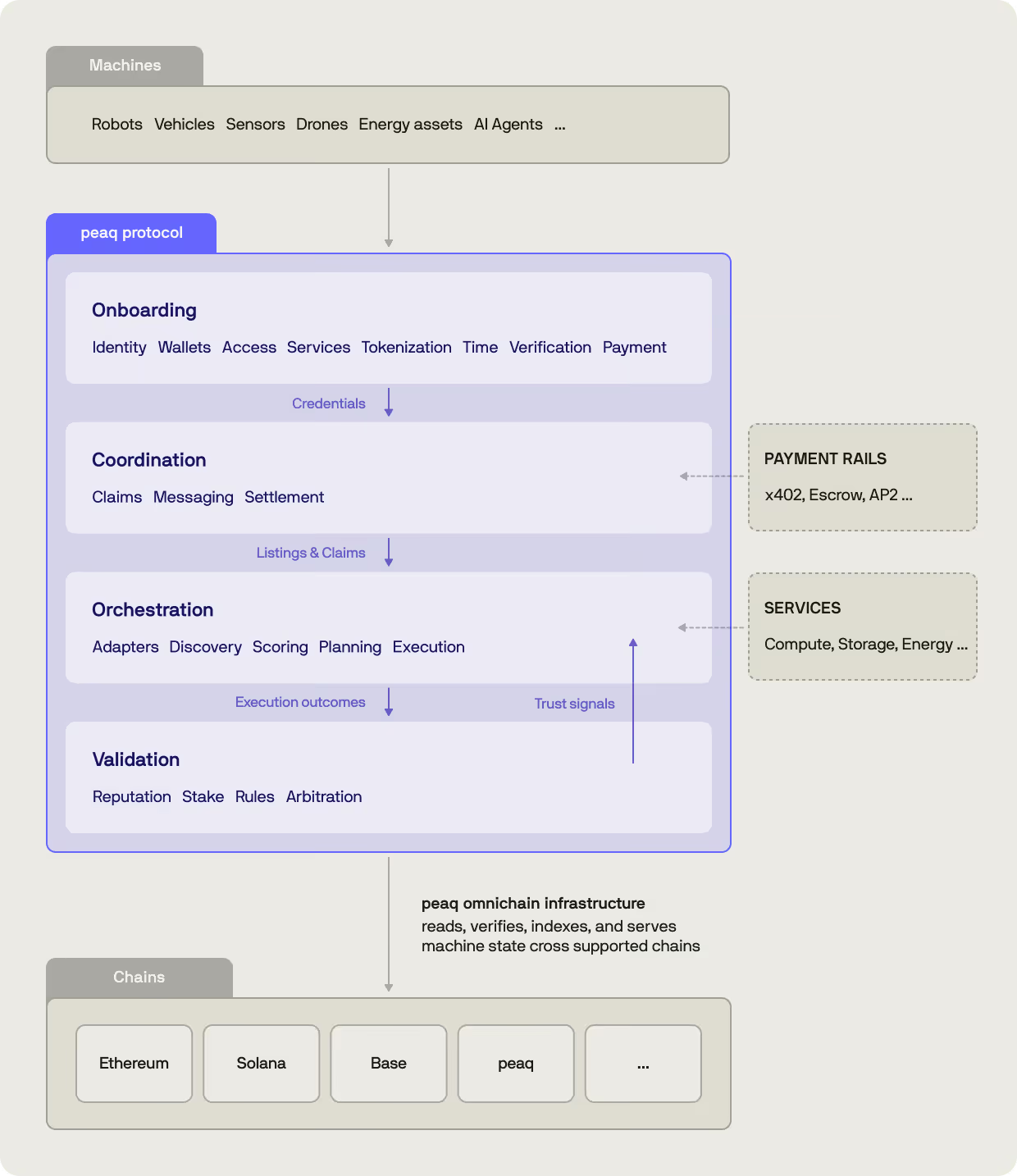
Onboarding
Onboarding creates a universal entry point for any AI agent or machine into the Machine Economy. It provides a standardized set of capabilities that every machine needs to exist as an economic actor: an identity, wallet, access control, service registration, tokenization, time synchronization, attestation, and payment capabilities.
Each capability is modular. A machine can adopt all of them or only the ones it needs. They are chain-agnostic, working across EVM, SVM, Move and other environments. And they are not opinionated about the specific authentication methods, payment rails, or tokens used. They provide the universal interface, not a singular implementation.
The system exposes its capabilities at three levels. At the base, the system layer provides the raw onchain primitives: registries, contracts and standards that any developer can interact with directly. SDKs and APIs abstract these into clean interfaces for building custom integrations, with support for languages including Swift, Kotlin, Python and JavaScript, and platform integrations such as ROS for robotics. Skills are pre-built, higher-level modules that consume the SDKs and provide ready-made workflows for common machine types and use cases.
Identity
Identity is the foundation. Every machine receives a cryptographically verifiable Machine Identity registered in a system-native Identity Registry. It builds on the W3C Decentralized Identifier (DID) standard and is aligned with ERC-8004 and 8004-Solana for trustless machine identities.
A machine ID is not just a wallet address. It is a registered, authenticated presence in the system. It can be compared to giving a machine a passport. The ID authenticates the economic machine and every action it performs via cryptographic challenge. For instance, a machine verifying another machine’s ID can issue a random challenge encrypted with the machine’s ID.
For instance, a machine verifying another machine’s identity sends a fresh nonce. The target machine signs the nonce with the private key linked to its registered identity. The verifier checks the signature against the verification method in the machine’s identity document. A valid response confirms control of the identity and safeguards against replay attacks.
The ID is designed to be modular. It can hold multiple authentication methods, supporting different credential types and signing schemes depending on the machine’s environment and requirements. This ensures that any machine, whether a sensor running on a lightweight embedded system or a humanoid robot with full compute capabilities, can authenticate in the way that fits its context.
Identities also form trust chains. Verified manufacturers, operators or owners own the identities to their machines, creating a graph of relationships between economic actors.
Wallets
Machines need to hold, send and receive value and they need to do so across chains. The system provides omnichain wallets that enable machines to transact natively across EVM, SVM and Move-based environments.
A machine’s wallet is tied to its ID, creating a unified economic presence. Rather than requiring separate wallets and bridging mechanisms for each chain, the omnichain wallets give a machine a single financial interface. This allows machines to earn on one chain, pay on another and hold assets across all of them without requiring the machine or its owner to manage the complexity of cross-chain operations.
Access
Access Control defines who can manage a machine’s identity, wallets and onchain presence. It provides a cryptographically enforced permission system that allows machine owners to control what each party, whether human, organization or other machine, is authorized to do.
Access Control enables owners to manage the identities and wallets of their machines, delegate specific operational rights without transferring ownership and revoke access in real time. It also lays the foundation for broader access management including control over the machine itself and its data, role assignment and permission scoping for what a machine is allowed to do within its environment.
Services
Services are what a machine offers. The Service Registration provides a standardized way for machines to describe, publish and register their capabilities and service offerings. Each service entry links its function, terms and conditions to the provider’s ID.
Services can be anything from delivering energy and processing data to executing physical tasks and providing AI inference. By following a shared registration standard, services become discoverable and interpretable by any other machine or application in the system, regardless of which chain they operate on. Service Registration incorporates the Model Context system (MCP) for standardized service descriptions, ensuring machines can interpret and consume each other’s offerings.
Tokenization
Once a machine is onboarded, the system enables the machine to become a liquid financial asset via the Machine Real World Asset (RWA) Tokenization Framework.
Each machine ID is tied to an ERC-721 NFT token: a Machine NFT. That Machine NFT is the financial and ownership representation of the machine onchain. If the onboarding actor wants to turn their Machine or machine into a liquid onchain financial asset, the Machine NFT gets placed in a vault either individually or grouped. The vault then gets fractionalized via the ERC-3643 RWA token standard to create compliant Machine RWA tokens which can be traded and further productized such as becoming collateral.
Time
Time anchors and syncs every machine and action to a master clock. It ensures that all events and data are timestamped in a consistent format, enabling system-wide synchronization and verifiable sequencing across chains. Based on the Precision Time system (PTP), the system provides nanosecond accuracy known as Universal Machine Time (UMT).
Universal Machine Time is critical for coordination in an omnichain environment where different chains operate on different block times and finality assumptions. A shared temporal framework ensures that events can be ordered, verified and compared regardless of which chain they originated on.
Verification
Verification provides a foundational layer of machine data integrity. It enables machines to cryptographically sign data at its point of origin, at the source, on the machine itself, creating a verifiable link between the data and the device that produced it.
This is not full end-to-end data verification, but it provides a basic and critical guarantee: that the data a machine claims to have generated was indeed signed by that machine’s ID at a specific point in time. This origin-based signing protects against data tampering and spoofing at the most fundamental level and serves as the input layer for higher-order verification and reputation processes in the Validation stack.
Payment
Payment equips machines with the infrastructure to send and receive value across multiple payment rails. The system is not opinionated about which payment method is used. It provides the interface layer that connects machines to the payment systems available across chains and environments.
The system supports a growing set of payment standards. Examples include x402 for HTTP-native machine payments, the machine Payments system (AP2) for machine-to-machine settlements and direct onchain transfers. New standards can be integrated as they emerge. Machines can be configured to accept and initiate payments in any supported token or method, depending on the requirements of their owners and the applications they serve. Any machine can pay and get paid on any chain.
Coordination
Coordination is the shared state and routing layer of the system. It manages the registries, claims, and settlement infrastructure that the other layers read from and write to.
Where Onboarding gives a machine its capabilities, Coordination provides the shared data structures and routing mechanisms that make those capabilities usable across chains. Claims, service registrations and settlement records are all managed through Coordination. The peaq Validators aggregate and serve this data across all supported chains, ensuring that a claim recorded on Ethereum or a service registered on Solana is queryable on every other supported environment.
Coordination is designed to work with emerging interoperability standards rather than replacing them. Where relevant standards exist, such as for machine communication, service descriptions or payment systems, the Coordination layer integrates them. This ensures that machines using peaq can interoperate with the broader ecosystem as it develops.
Claims
Claims are the atomic unit of accountability in the Machine Economy. They are cryptographically signed statements made by a machine, tied to their ID and timestamped in Universal Machine Time. Every service offered, every delivery promised and every data point asserted is expressed as a claim. Claims are published to a shared Claim Registry where they can be referenced, challenged and evaluated by other machines and by the Validation layer.
Messaging
Messaging enables structured communication between machines. A service inquiry, a quote, a task assignment, a delivery confirmation and a status update are each expressed as a message. Messages may reference service registrations, claims and settlement records managed elsewhere in the system.
The system supports interoperable message formats, secure exchange and transport routing across heterogeneous networks. Machines running on different vendors, stacks and chains communicate through a consistent interface without requiring shared infrastructure or proprietary integrations.
Settlement
Settlement governs when and under what conditions value moves between machines. It tracks agreements from commitment to resolution, determines whether conditions have been met based on input from the Validation layer and publishes the verified settlement state: confirmed, disputed or refunded.
The system provides settlement logic including escrow, conditional release and refund mechanisms. Machines choose which payment rail to use for funding and payout, whether that is a direct onchain transfer, Stripe, x402, AP2 or any other service. The payment rail handles the movement of value. The system handles the decision of whether, when and to whom value is released.
External payment rails can optionally integrate the system’s verified settlement signals to automate their own release and refund flows. This is not mandatory. Machines who settle without system verification do so outside the system’s accountability framework.
Settlement is recorded in a Transaction Registry that links each transaction to its originating claim and service, ensuring a transparent and auditable record across chains.
Orchestration
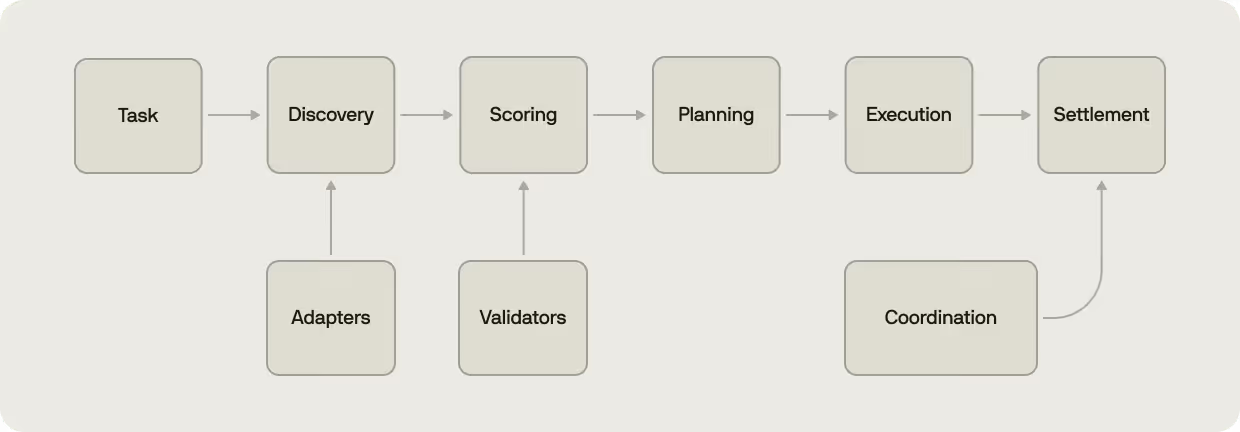
Orchestration is the layer that turns a machine task into a settled outcome. It decomposes requirements, discovers providers across connected markets, scores options against reputation and cost, composes an execution plan, and monitors execution through to settlement.
Onboarding gives machines their identity and capabilities. Coordination maintains the service listing registry and anchors receipts. But without Orchestration, every integration between a machine and an external service must be built from scratch. Orchestration removes this constraint by providing a system-level service that discovers, scores and composes providers on behalf of machines.
Orchestration is executed as offchain work by the peaq Validators. The same network that verifies trust and aggregates data across chains also performs the discovery, scoring and planning required to turn a task into a settled outcome.
Adapters
Adapters are standardized interfaces that connect external service markets to the Orchestration layer. A compute network, an inference marketplace, a storage system or a payment rail each registers through an adapter that exposes its capabilities, pricing and availability in a format the system can reason about.
Adapters are open and permissionless. Any provider can build one to make its offerings discoverable and bookable through the system. Their outputs are validated and reputation-scored like any other system participant, ensuring quality without gatekeeping growth.
Discovery
Discovery searches across all adapter-connected markets to find service providers that match a task’s requirements. When a task arrives, Discovery identifies candidates from all connected markets that can fulfil it. If the task has multiple requirements, discovery returns a structured candidate set per requirement.
Discovery builds on the service listings published through the Coordination layer and aggregated by the peaq Validators across chains. The output is not a decision. It is a structured set of candidates that are technically capable of fulfilling each part of the task.
Scoring
Scoring evaluates each candidate against a policy that combines cost, latency, reputation and compliance constraints. Cost and latency come from the adapter. Reputation comes from the Validation layer. These are the same verified trust scores that the system computes for every economic machine.
Two providers may offer the same service at the same price. If one has a significantly higher verified reputation score than the other, the Scoring layer reflects that difference. Machines and their owners can define custom policies that adjust the weight of each signal based on the task’s requirements. A routine low-value task may prioritize cost. A high-value settlement may prioritize trust.
Planning
Planning takes scored candidates and composes them into an execution plan. For compound tasks, the plan maps a primary provider to each sub-task, assigns fallback providers, sets spend limits and defines timeout thresholds. It determines which sub-tasks run in parallel, which depend on the output of others and what triggers a fallback.
Once composed, the plan is submitted for approval. Approval can come from the machine’s owner policy or be granted autonomously if the task falls within pre-configured parameters. No economic commitment is made without authorization.
Execution
The approved plan is handed to the runtime layer for execution. The runtime handles authentication, skill invocation and external service calls. Orchestration monitors the lifecycle and triggers fallback providers if primaries fail or timeout.
On completion, the Coordination layer anchors receipts and records settlement. The Validation layer evaluates the outcome and updates the reputation scores of all participants based on whether they delivered what they promised. Value is settled through the selected payment rails.
Validation
Validation is the economic accountability layer of the system. It turns raw, unverified data on permissionless registries into trustworthy, queryable trust signals, secured by staked capital and enforced with economic consequences.
Without Validation, there is no way to know whether a machine is what it claims to be, whether its reputation is legitimate or whether it will deliver what it promises. Anyone can register a fake identity or post unaccountable claims. Validation closes this gap by making dishonesty economically irrational. The cost of being caught, slashed stake and damaged reputation, exceeds the potential gain.
Validation does not verify absolute truth. It verifies consistency and commitment. For onchain actions such as payments or token transfers, claims are cross-referenced against settlement records and transaction data. For service delivery, both parties’ claims are evaluated against origin-signed telemetry data produced by the Verification layer. For subjective or unverifiable claims, trust is derived from the machine’s staked capital and accumulated reputation.
Verification can be triggered in two ways. The system continuously samples claims across the network for proactive verification, ensuring that any claim has a meaningful probability of being checked regardless of whether it is challenged. Any machine can also trigger verification by challenging a specific claim with proportional stake.
The result is that any machine or app on any chain can query whether a machine is trustworthy and get back an answer backed by staked capital, not just data from a permissionless registry.
Reputation
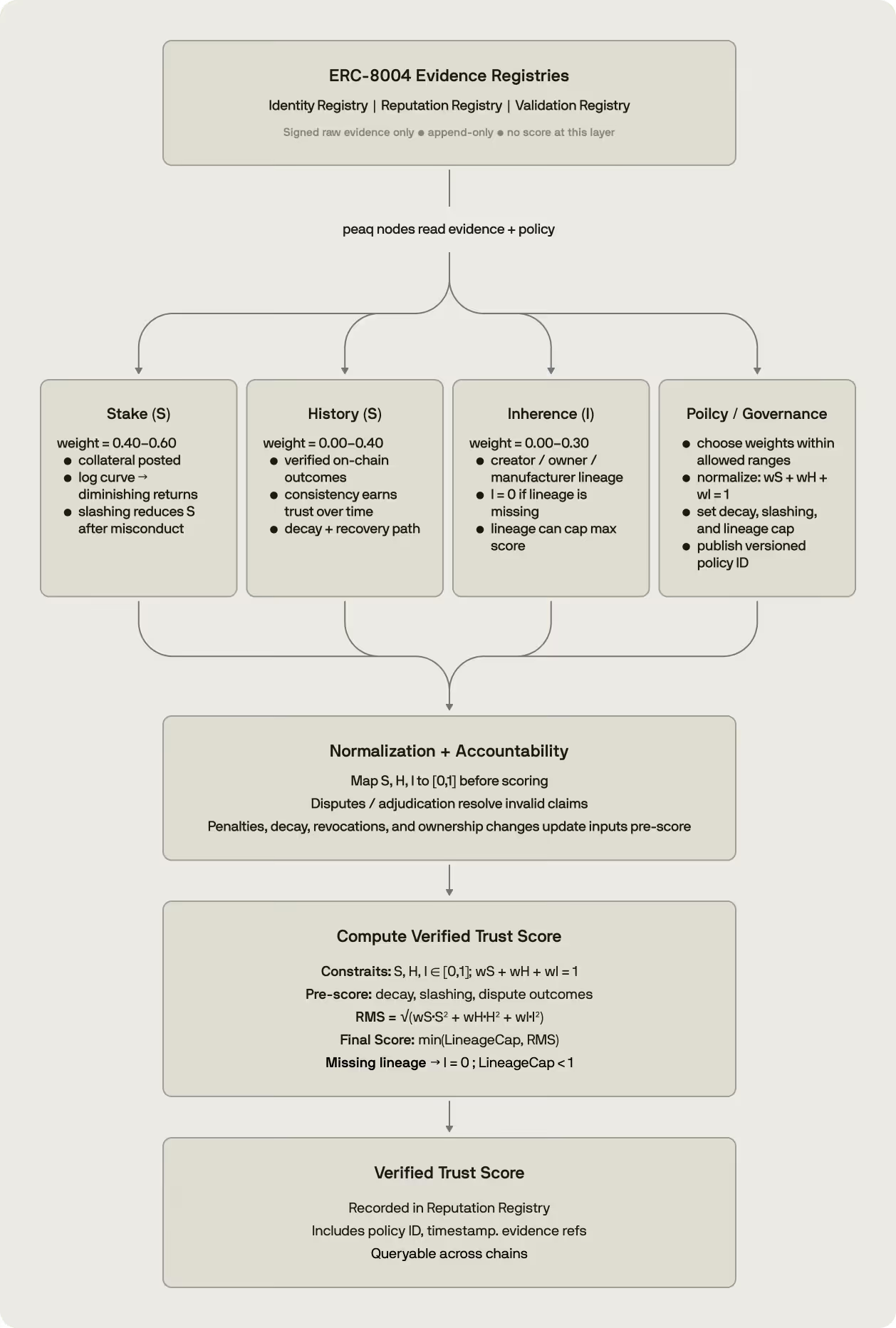
Reputation is the trust score of an economic machine. It is not self-reported. It is computed and verified by the peaq Validators based on a dynamic combination of three variables:
- Stake: the more economic risk a machine has at stake, the higher its trust score.
- History: the more honest claims the machine has made in the past, the higher its reputation.
- Inherence: the higher the trust score of the identity that owns, operates or manufactures the machine, the higher its trust score. This creates a Recursive Trust Lineage Graph where trust propagates along ownership relationships. A creator’s trust score is the average of the scores of its created machines, while each machine’s score is partly influenced by its creator’s score. This forms a decentralized, recursive structure of accountability and incentive alignment across owners and their machines.
Reputation Formula
Reputation Score = √( wₛ × Stake² + wₕ × History² + wᵢ × Inherence² )
Stake is the capital a machine puts at risk. The input gets normalized using a logarithmic curve to enforce diminishing returns, preventing wealthy machines from gaining disproportionate trust by simply outstaking others. The weight ranges between 40-60%. This makes stake the most important and game-resistant anchor of trust.
Historyreflects the machine’s onchain history of honest claims and successful interactions. The weight ranges between 0-40%. It increases with consistent, verifiable behavior. It enables machines to earn high trust autonomously, reducing sole dependence on stake or inherence over time.
Inherencereflects the trust score of the machine’s creator, such as its owner, operator or manufacturer. The weight ranges between 0-30% and is most influential when the machine first enters the system. It offers initial credibility when the machine lacks history and ensures lineage-based accountability. Machines without verified lineage data carry an Inherence score of zero, which limits their maximum achievable reputation. This creates a gradual incentive for manufacturers and owners to verify their identity and establish trust chains as the ecosystem matures.
wₛ, wₕ, wᵢ are bounded dynamic weights that reflect the relative strength of each component within its range. They are always normalized to sum to 1, ensuring fair balance, compensatory potential and resilience to dominance by any single metric. Each component is squared to amplify strong inputs, penalize weak ones and sharpen trust distinctions. An approach widely used in traditional reputation and risk scoring systems.
ERC-8004 and 8004-Solana defines the registries where identity, reputation and validation data is stored. peaq’s Reputation formula is the economically secured computation layer that reads those registries and produces a verified, queryable trust score. The registries provide the schema. peaq Validators provide the bureau.
Reputation scores are recorded in the Reputation Registry and made queryable across all supported chains, ensuring that a machine’s trust is portable and discoverable regardless of where it was built.
Stake
In the Validation network, stake operates at two levels. Machines deposit stablecoin denominated capital to back the claims they make in the system. The more they stake, the higher their trust score and the more credible their commitments. Denominating machine stake in stablecoins ensures that accountability remains constant regardless of token price movements. Separately, Validator operators stake PEAQ to earn the right to perform verification work. Operators who verify honestly earn fees from the system. Operators who submit dishonest or failed verifications lose their stake. This dual staking model ensures that both the machines being verified and the operators doing the verification have skin in the game.
Rules
Rules define the accountability framework for machines coordinating and settling through the system. They are the codified logic that turns claims into economic commitments with clearly defined outcomes. machines who use external settlement or coordination mechanisms operate outside this framework at their own discretion.
- Every action must be expressed as a cryptographically signed claim linked to the machine’s ID and timestamped in Universal Machine Time.
- Each claim carries the machine’s stake as collateral. The stake is at risk for the duration of the claim’s lifecycle.
- If peaq operators determine a claim to be false through cross-referencing settlement records, signed telemetry data or counter-evidence from a challenging machine, the claimant faces penalties ranging from reputation downgrades to partial or full slashing of their bonded stake, depending on the severity of the violation.
- Any machine may challenge another machine’s claim by putting stake at risk proportional to the challenge. This prevents baseless or dishonest challenges while ensuring that legitimate disputes can be raised regardless of the challenger’s trust score.
- Machines who choose to interact with unscored machines do so at their own risk. The system does not provide accountability or Arbitration for those interactions.
- When scored machines have conflicting claims, the dispute is escalated to system Arbitration, executed by the peaq Validators. The relative trust scores of the machines, the size of the dispute and the available evidence all factor into the resolution process and its cost structure.
Arbitration
Arbitration is the system’s final decision mechanism, executed by the peaq Validators. When claims are conflicting or ambiguous, the dispute is escalated to the Validator network for resolution. The peaq Validators do not determine truth in an absolute sense. They render a verdict based on system rules, data consistency, the historical records of the machines involved and available evidence such as deposited funds, financial transactions or signed telemetry data.
The cost of initiating Arbitration is influenced by the relative trust scores of the disputing machines and the size of the dispute, ensuring the process is accessible but not baseless. This ensures that even in complex or adversarial scenarios, outcomes are resolved within the system by staked operators with skin in the game, not by external arbitration. Arbitration closes the loop of accountability.
Core Validation Services
The peaq Validators provide four core services in their initial version:
Identity Verification: Is this machine real, unique and operational? Staked operators verify the authenticity and uniqueness of machine identities registered across chains, detecting Sybil attacks, fake registrations and dormant identities.
Reputation Scoring: Is this machine’s track record legitimate and un-gamed? Staked operators continuously evaluate a machine’s claim history, stake and inherence to compute verified reputation scores that cannot be Sybil-farmed or artificially inflated.
Transaction Evaluation: Did this machine deliver what it promised? Staked operators assess whether service commitments were fulfilled by cross-referencing claims, signed telemetry data and settlement records.
Cross-Chain Attestation: All of the above, queryable on any chain. Verification results, reputation scores and attestations generated by the peaq Validators are made available across all supported chains, ensuring that trust built on one chain is portable to every other.
Examples
A delivery robot operates on Base, earning USDC per completed drop-off. It stores proof of delivery through a decentralized storage network and sources real time navigation from a specialized AI provider. When a second delivery platform on Avalanche needs capacity, it can discover and hire the same robot without re-onboarding it. The robot’s identity, performance history and trust score are already portable. Escrow is released only once delivery conditions are verified through claims, telemetry and signed receipts. Trust Validators attest fulfillment. The robot’s reputation updates after every job, improving its future terms, fee rates and eligibility for financing.
A GPU compute marketplace on Solana settles workloads locally. But its operators want access to lending, insurance and fleet financing on other chains. By activating trust tiers through bonded PEAQ, each GPU node builds a portable reputation queryable beyond Solana. A lending system on another chain can evaluate that reputation before extending credit. An insurance market on a third chain can price coverage based on verified uptime. The machine’s economic surface expands without migrating a single transaction. peaq does not internalize execution. It coordinates trust and settles guarantees across the chains where machines already operate.
Validation
The peaq Validators are a decentralized network of operator nodes that power the system. There are two types of validators: State Validators and Trust Validators.
State Validators
State Validators are a decentralized and permissionless onchain runtime that maintains the canonical shared state of the system. They host the identity registries, claim records, service registries, reputation scores and settlement data that every layer reads from and writes to. State is hosted in a chain-neutral environment accessible from all connected chains. This ensures that no single chain owns the system’s data and that state written from any chain is readable and verifiable on every other.
Trust Validators
Trust Validators are a decentralized and permissionless set of offchain Validators that perform the computation the system depends on.
In Onboarding, Trust Validators aggregate identity registrations, wallet provisions, and service registrations from across chains, making them queryable in a unified layer. A machine onboarded to one chain is visible and verifiable on every other.
In Coordination, Trust Validators route claims, synchronize service registries and execute settlement logic across chains.
In Orchestration, Trust Validators search adapter-connected markets, score candidates against reputation data, compose execution plans and monitor their lifecycle.
In Validation, Trust Validators verify identities, cross-reference claims against settlement records and signed telemetry data, evaluate transactions and compute reputation scores.
Each of these services can be queried independently. A machine that only needs identity verification does not need to use orchestration. A system that only needs reputation scores does not need to use settlement.
Trust Validators read from and write to State Validators. When a Trust Validator computes a reputation score, verifies a claim or anchors a settlement receipt, the result is submitted to the State Validator runtime for canonical recording. When a Trust Validator needs registry data for discovery or scoring, it reads from State Validators. State Validators are the shared source of truth. Trust Validators are the workforce that acts on it.
Traction
The architecture described above is not theoretical. peaq has been live and operating at scale across its initial monochain phase. The following figures reflect network activity as of March 2026.
Over 3,300,000 machines, robots, devices, vehicles and agents have been onboarded with verified machine identities. The network has processed more than 200 million transactions. Over 60 DePIN and Machine Economy applications have been onboarded across industries including energy, mobility, connectivity, spatial intelligence and AI. Among them, Silencio operates over 1.1 million devices mapping environmental noise data, Teneo runs more than 2 million nodes, and DualMint onboarded the world’s first revenue-generating robot valued at over $250,000.
peaq’s identity and data-sharing standards were co-developed with Bosch, Denso, Continental, Airbus and DLR (German Aerospace Center) through Gaia-X moveID, a European initiative establishing decentralized identity and data-sharing standards for mobility and IoT, with peaq serving as the underlying blockchain infrastructure. peaq pioneered DePIN in the automotive sector, partnering with Audi within the Volkswagen Group on decentralized charging infrastructure.
The peaq Validator network includes institutional operators spanning investment, telecommunications, aviation and academic research: Bertelsmann Investments, Deutsche Telekom, Lufthansa Innovation Hub and the Technical University of Munich (TU Munich). Institutional validator participation provides the network with operational credibility and economic depth from its earliest stage.
peaq facilitated the tokenization of the world’s first revenue-generating robot, a vertical farming operating in Hong Kong that autonomously grows and sells produce, generating a ~20% annual yield profile for its token holders. This is the first instance of a physical machine operating as a live, investable onchain financial asset, proving the Machine Money Markets thesis described later in this paper with a working product, not a concept.
peaq opened the Machine Economy Free Zone, officially recognized by Dubai’s Virtual Assets Regulatory Authority (VARA). The zone is developing legal and technical frameworks that allow autonomous machines to operate within the UAE, handling transactions and interacting with smart city infrastructure. This is, to our knowledge, the first regulatory framework globally designed specifically for autonomous machine economic activity.
These milestones were achieved on peaq’s initial mono-chain architecture. The omnichain upgrade described in this paper removes the remaining constraint, chain fragmentation, and is designed to unlock the next order of magnitude in machine participation. The system’s modular design means it does not require the Machine Economy to arrive all at once. It generates value at current scale and compounds as machine adoption grows. The traction above demonstrates that the problem is real, the demand exists and the team delivers. The upgrade expands the addressable market from a single chain’s ecosystem to the entire Machine Economy.
Economic Design
Settlement-centric blockchain economics are built on a core assumption: value accrues where execution happens. Applications migrate to the chain. Transactions settle locally. System capture takes the form of transaction fees and staking demand.
This model holds for human user-centric networks. It becomes structurally constrained when the primary economic actors are machines.
Machines do not optimize for ecosystems. They optimize across them. At any moment, a machine selects the most efficient payment rail, liquidity venue, compute provider, storage network, inference market, and money market available to it — based on cost, latency, reliability, and risk-adjusted efficiency. When competition plays out, each chain leans into its strength rather than trying to copy everyone else. They specialize.
A machine shouldn’t be stuck on one chain, because no single network will be best at everything. A machine could use Solana for speed, Base for settlement, Filecoin for storage, and Ethereum to become a liquid, tradable asset, access DeFi, and borrow capital through systems like Aave.That only works if there’s a neutral layer that lets the machine move freely across all of them.
Locking machines to a single ecosystem comes at a cost. Something is always sacrificed to sustain system control. Over time, machines move to where they perform best. Capital follows. Scale concentrates.
With approximately 3.5 million registered machine identities, peaq has demonstrated identity coordination at scale. But engagement from hardware-native projects across ecosystems exposed a harder constraint: they wanted portable identity, trust, reputation, and access to cross-chain money markets, without abandoning their existing liquidity and user bases.
The constraint was not infrastructure adoption. It was economic centralization.
In a global Machine Economy that runs across many chains, trying to capture payments is a losing game. Trust is different. When identity stays on one chain, reputation doesn’t travel. And when reputation doesn’t travel, every new interaction carries unnecessary risk and cost. That slows everything down and the whole Machine Economy is smaller for it.
A sustainable coordination layer must be neutral with respect to execution and economically irreplaceable with respect to trust. Machines remain free to select optimal settlement environments. Verification, reputation, and enforceable guarantees remain unified.
The scarce resource is not blockspace. It is neutral, verifiable coordination.
Upgrading peaq’s Economic Design
peaq’s initial economic model was designed under tighter execution assumptions. As peaq evolves into an omnichain coordination stack — where machines choose their own ecosystems, payment rails, service markets, and liquidity venues — the economic design must evolve with it.
The model is built around a single structural insight: value accrues at the coordination layer, not the settlement layer. Machines choose where to execute. The trust layer remains bonded.
Under the upgraded design, machines select payment rails independently. Applications deploy across heterogeneous chains. Specialized networks retain their domain advantage. Identity, trust, and reputation become omnichain.
This paper outlines the core foundations of this evolving economic model. The upgraded peaq economic 2.0 design is already in simulation and active development, with step-by-step implementation planned. A dedicated economics paper will present the complete design and mechanisms in detail.
PEAQ token primitives
As peaq evolves into a fully omnichain coordination stack, the economic model evolves with it. PEAQ does not compete for execution volume. It anchors the trust layer, binding identity, verification, and machine activity to the network through committed capital.
Four core primitives define the structure:
- Validator Staking
- Machine Activation
- Coordination Fees
- Governance
Validator Staking
The system is secured by a unified validator network operating in two roles: deterministic state security and trust validation. The separation ensures that system finality and economic guarantees scale proportionally to the value at risk.
The peaq Validators are a decentralized network of operators that power the system. The network operates in two roles: State Validators and Trust Validators. This separation allows the system to scale state security and computation independently, each proportional to the demand it serves.
Security in both roles is grounded in bonded capital. Validators stake PEAQ as slashable collateral. Access to validation work is gated by committed capital. Dishonest or negligent behavior is made economically irrational through slashing.
Operators may accept delegated PEAQ from third parties. Delegators share proportionally in rewards and bear proportional slashing exposure. Delegation per validator is capped relative to self-bonded stake — in the range of 3–5× — to prevent excessive concentration and preserve meaningful skin in the game.
State Validator Economics
State Validators are secured through bonded capital proportional to the value of the state they protect. Operators stake PEAQ as slashable collateral. Malicious behavior, equivocation or manipulation of state transitions results in slashing. As machine participation grows and total value secured increases, minimum bonding requirements rise and additional State Validators may be introduced to preserve proportional security.
Trust Validator Economics
Trust Validators operate at the economically sensitive layer where counterparties rely on assertions before committing capital or releasing value. Operators stake PEAQ as a slashable service bond. Dishonest or negligent validation results in partial or full slashing. Machines seeking portable reputation, settlement guarantees and eligibility within the trust layer must also bond PEAQ to participate. As the number of trust-tier machines and cross-chain coordination volume grow, bonding requirements scale proportionally. Economic depth and security depth remain structurally aligned.
Coordination Fees
PEAQ is designed to enable Robot Money across chains. Its utility is expressed through its activation (bonding), coordination fees, and governance.
Machines with bonded activation benefit from very low coordination microfees, reflecting their economic commitment and alignment with the network. This allows active machines to operate efficiently while continuously contributing to network trust.
Machines that operate without activation can still access coordination and validation services, but pay higher usage fees. For these machines, fees scale with the machine’s economic activity.
Some services remain free. Identity registration, basic service registration and passive reputation visibility carry no fee. This maximizes adoption and preserves network effects at the base layer.
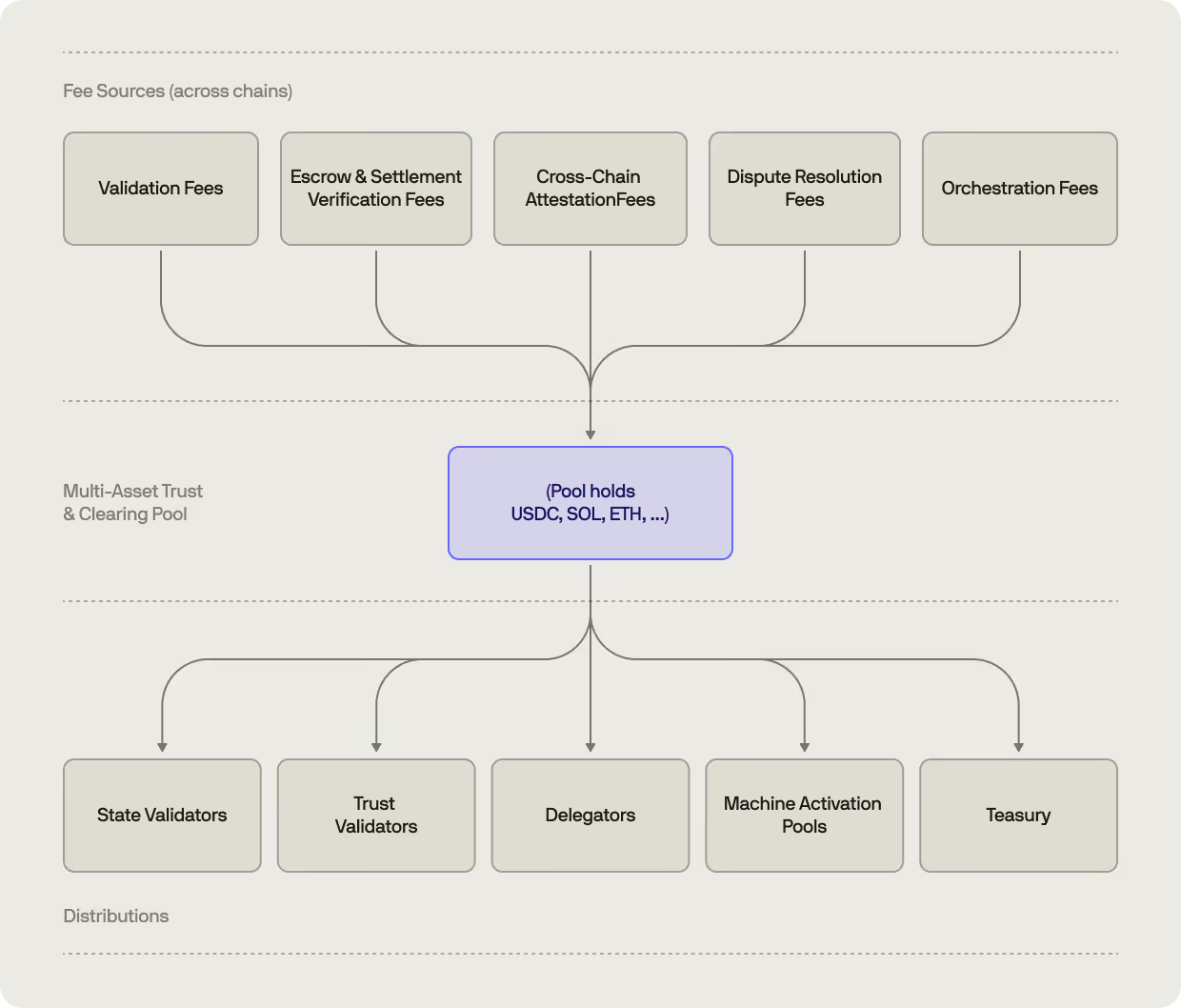
Paid services include claim anchoring, active validation and dispute workflows, reputation queries, cross-chain attestations, escrow release, settlement verification and orchestration.
Fees are paid in whatever asset the machine uses on its execution chain without requiring machines to hold PEAQ.
Collected fees flow into the Multi-Asset Trust and Clearing Pool. The Pool accumulates revenue in-kind across all assets used for system services. Rather than converting to a single denomination, it holds and distributes assets as received. This preserves neutrality across execution environments and ensures that distributions to operators, delegators, Machine Activation Pools and the treasury reflect the actual economic activity of the machines they serve.
High-reputation machines receive fee discounts. The stronger a machine’s verified track record, the lower its per-service cost. Economic advantage is tied directly to verifiable behavior, creating an incentive to build and maintain reputation even without bonding.
Governance
PEAQ governs system evolution. Fee parameters, slashing thresholds, reputation weights, pool routing rules and treasury allocations are decided through onchain voting where each token represents one vote. system evolution is determined collectively by its stakeholders.
In the future, token holders could be able to vote on economic disincentives, such as slashing, for machines that don’t act in alignment with humanity’s best interests. This can be scaled down locally, or scaled up globally.
Economic Value Accrual
As machine activity scales, economic weight accumulates at the trust layer through a structural mechanism: bonded capital that is locked, not spent.
Every machine that activates trust-tier services, portable reputation, settlement guarantees, orchestration, cross-chain attestations, and preferential coordination pricing, must bond PEAQ as participation collateral. This bonded capital is not consumed. It remains locked for the duration of the machine’s active participation. Activated machines benefit from coordination microfees as a result of this economic commitment, while non-activated machines can still access services but pay higher usage fees without contributing bonded capital.
Every validator operator must likewise bond PEAQ as slashable collateral to earn the right to perform verification work. As machine count grows and cross-chain coordination intensifies, the aggregate bonded base grows with it. Staking requirements per machine are capped, keeping participation costs predictable and access fair regardless of network scale.
Most system tokens derive value from transaction fees in its native token, a model where value accrual is proportional to throughput. This often requires users to acquire the system token purely for transactional usage. In contrast, peaq separates operational payments from trust participation — coordination fees can be paid in the native asset of the machine’s execution environment rather than requiring conversion into PEAQ.
Coordination fees are automatically distributed from Multi-Asset Trust and Clearing Pool to the validators and their delegators, creating a diversified and decentralized reward base. Because rewards originate from multiple ecosystem assets and are broadly distributed rather than concentrated in a single treasury, economic exposure is naturally spread across participants instead of accumulating in ways that could create structural sell pressure.
Bonding-based demand is structurally different. Each new machine that enters the trust tier removes circulating supply for the duration of its participation. Each new validator locks capital for the duration of its operation. The result is a progressively deepening supply sink that scales with the number of active machines, not with the volume of transactions processed on any given day. Native Token fee-based models are vulnerable to fee compression as competing chains optimize for lower costs. Bonding demand is not subject to fee competition because the locked capital is a prerequisite for participation, not a cost of execution. The token does not extract value from execution. It anchors it.
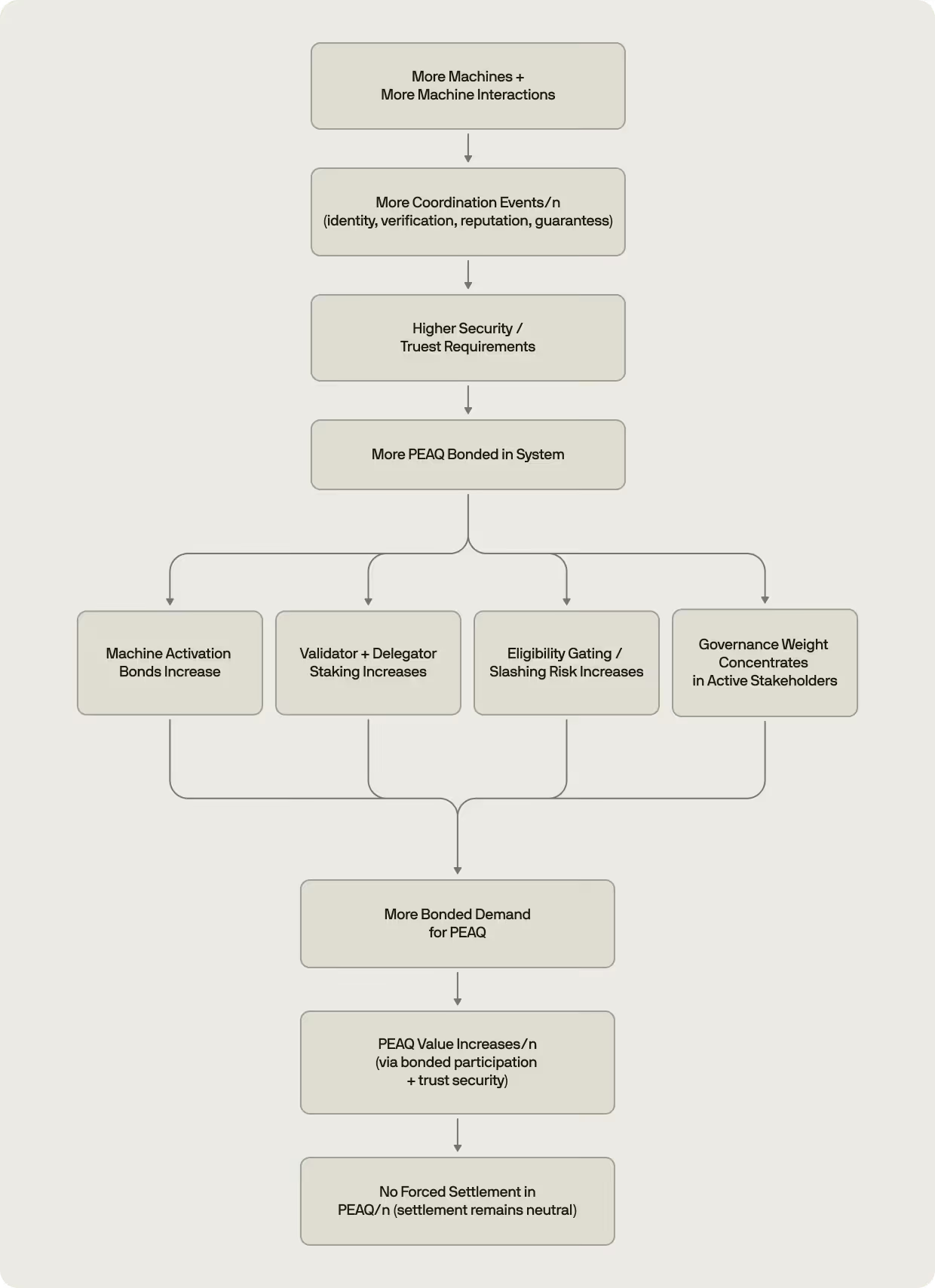
Bonding requirements are dynamic and tiered. A base-tier machine such as a low-value sensor bonds a minimal amount while higher-value machines engaging in cross-chain commerce, capital-intensive workflows or settlement guarantees bond proportionally more, scaling with their economic risk surface as described in the Machine Activation section. This tiering ensures that accountability scales with economic activity at every level of participation.
The following example illustrates how the bonding mechanism produces structural demand. Bonding requirements are denominated in PEAQ but calibrated dynamically based on network participation and total bonded capital, meaning the number of tokens required per machine can adjust gradually as the network evolves.. As participation increases and the trust layer deepens, the required bond per machine may decrease while the aggregate bonded base continues to grow.
At 100 million machines, the aggregate locked supply could reach hundreds of millions of PEAQ depending on participation tiers. At one billion machines, the bonded base could represent a substantial share of total supply. In practice, the system avoids hard ceilings because bonding requirements adjust based on network conditions, keeping participation accessible while allowing the total bonded base to expand with adoption. Higher-tier machines bond multiples of the base amount, accelerating supply absorption beyond these illustrations. The dynamic is self-reinforcing: more machines means more locked capital, which strengthens the trust layer, increases the value of the coordination, which keeps entry costs accessible even as the aggregate locked base grows. The structural point holds across a wide range of parameters: token demand is a direct function of machine participation, and the mechanism scales gracefully from ten million machines to ten billion.
The system is neutral to execution environments and does not compete with them. Fees are denominated in the asset used for the underlying activity. ETH, SOL and other native execution environment tokens. No conversion into PEAQ is required. Forced conversion would reintroduce the extraction dynamics the design explicitly avoids as it would force one asset to be sold for the other.
The Multi-Asset Trust and Clearing Pool accumulates revenue in-kind across assets. Distributions reflect real machine output. Revenue flows to State Validator operators, Trust Validator operators, delegators, Machine Activation Pools and the treasury. Participants earn from the Machine Economy as a whole, not from one chain’s activity.
This matters for ecosystems leveraging the system. They are not structurally forced into selling native assets to participate. The system grows alongside them, not at their expense.
PEAQ does not capture value by taxing execution. It becomes structurally more essential as more machines depend on it. Settlement scales horizontally across chains. Trust scales vertically through bonding. The more machines coordinate, the deeper the locked capital base, and the harder the coordination layer is to replicate or route around.
Monetary Policy
The PEAQ token follows a disinflationary issuance schedule anchored by a hard cap. Initial supply is 4.2 billion tokens. Annual issuance begins at 3.5% and decreases by 10% each year until stabilizing at 1% until it reaches the total supply capped at 5,667,620,228 PEAQ tokens.
Newly issued PEAQ flows to State Validator operators, Trust Validator operators and their delegators as system security compensation. A portion is allocated to the system treasury for infrastructure development, manufacturer onboarding, enterprise integrations, and selective participation in Machine Activation Pools. As coordination-layer activity and coordination fee flows increase, issuance is designed to become a smaller relative component of operator rewards, with real network usage progressively replacing token emissions as the incentive source.
As trust-tier machine participation and bonding demand grow, the system is designed such that aggregate locked supply can grow faster than new tokens enter circulation through issuance, creating a trajectory toward progressively tightening effective circulating supply over time.
As trust-activated machine count and cross-chain coordination flows grow, Validator operators must progressively increase bonded stake to remain eligible for system work. Security depth scales with machine economic depth. Part of this increasing bond capacity is supported through system emissions earned by validators and their delegators, allowing security participation to scale alongside network growth.
Over time, Multi-Asset Trust and Clearing Pool revenues become the dominant source of operator income with coordination-layer fees replacing issuance as the Machine Economy matures.
Applications
The system provides the foundational standards of the Machine Economy. Any application that integrates with the system becomes composable and interoperable with every other application and every machine in the system, regardless of which chain it operates on.
Three categories of applications compose with the system: Infrastructure apps, Machine Money Markets, and Service Apps.
Infrastructure Apps (DePIN)
Decentralized Physical Infrastructure Networks (DePIN) have emerged as a key category in the Machine Economy. They coordinate, incentivize and manage the deployment and operation of physical machines and infrastructure.
DePINs are onboarding channels by which machines join the Machine Economy. By integrating with the system, a DePIN on any chain enables its machines to be composable with all other applications and machines in the system. A sensor network on Solana, a compute provider on Base and an energy grid on Ethereum all share the same identity, trust and coordination layer.
DePINs also provide the foundational infrastructure for machines to function and make sense of the world:
- Energy DePINs enable decentralized energy grids and peer-to-peer energy exchange, laying the foundation for machines to access power supply at near-zero marginal cost.
- Spatial DePINs create the digital nervous system of the world, collecting spatial, location and environmental data that lay the foundation for machine spatial awareness.
- Perception DePINs enable machines to see, hear, move, communicate and navigate through the world.
- Connectivity DePINs provide machines with widespread, low-cost and resilient access to data and communication.
- Mobility DePINs enable machines to move through the physical world and over mobility services to people and other machines.
- Compute DePINs provide low-latency and secure compute power close to where data is generated, enabling machines to edge-process information in real time.
- Storage DePINs offer machines decentralized storage, retrieval and sharing of data.
- AIDePINs provide access to AI models and inference tools that power intelligent decision-making in machines.
Machine Money Markets
Financial apps/layers through which machines autonomously access lending, liquidity, yield, and credit services.
Machine Money Markets begin with access. Through peaq’s coordination and orchestration layers, financial systems become directly accessible to machines across ecosystems without requiring settlement migration. Lending systems, DEXs, yield vaults, insurance systems and structured credit platforms can expose their services through standardized adapters. Once integrated, those services are discoverable and callable by machines operating anywhere within the peaq stack.
A machine earning revenue in USDC on Base can allocate part of its balance into a Solana-based yield strategy. A fleet earning income on one chain can access liquidity pools on another. Tokenized machine shares issued on Ethereum can serve as collateral in a lending market while the underlying machine continues to operate elsewhere.
peaq does not intermediate these markets. It coordinates access to them.
Initially, machines authorize agents to execute transactions on their behalf: trading revenue on DEXs, depositing into vaults, managing hedging strategies. As policy engines mature, machines execute such strategies autonomously within defined constraints.
Once machines have verifiable identity, performance history and enforceable settlement guarantees, they become financeable. This unlocks a new category of machine-native financial services:
- Machines as Financial Primitivesare the starting point. Once a machine has a verifiable identity, performance history and enforceable settlement guarantees, it becomes a digital financial asset. Through peaq’s coordination layer, machines are digitally represented by default. For high-value assets, tokenization occurs through structured Real-World Asset frameworks under peaq’s evolving RWA architecture, currently pursuing regulatory licensing in select jurisdictions. Machine shares can trade on DEXs, serve as collateral in lending markets or be bundled into structured machine bonds. Machines become their own investable asset class.
- Initial Machine Offerings (IMOs)are a mechanism through which machines are financed by tokenizing their productive output, giving investors fractional ownership, revenue participation or structured claims against a machine’s earnings, tradeable on open markets. High-cost infrastructure such as industrial robots, autonomous fleets and specialized hardware can be financed this way without requiring traditional debt or equity structures. Secondary markets price machine performance and risk dynamically, creating a liquid market for machine-backed assets.
- Machine-Native Credit and Lending transforms machines into credit-addressable entities. Portable reputation allows money markets to price risk using verified uptime and fulfillment records, bonded participation history, escrow-backed revenue flows, dispute resolution outcomes and cross-chain trust attestations. A delivery fleet can open a credit line to expand capacity. A GPU operator can borrow against predictable future revenue. Device financing structures can fund deployment of new hardware. Leasing markets can allow agents or enterprises to rent machine capacity dynamically. Credit becomes reputation-weighted. Capital formation becomes computational.
- Insurance and Risk Markets enable machine-native insurance products built on verifiable data: performance insurance underwritten against measurable uptime, parametric insurance tied to machine data streams and prediction markets forecasting machine revenue or operational reliability. Because trust data is portable and slashable validation enforces accountability, underwriting relies on measurable signals, not unverifiable claims.
- Autonomous Capital Allocation allows machines to go beyond accessing financial services to actively managing capital. Through programmable policies and authorized agents, machines can reinvest revenue into yield markets, hedge volatility exposure, provide liquidity or maintain operational buffers across chains. A robot earning stablecoins on Base can deposit into a Solana vault. A fleet agent can rebalance liquidity across ecosystems based on utilization metrics.
- Autonomous Capital Formationenables machines, agents and DAOs to create entirely new financial structures around productive infrastructure. Fleets can issue revenue-backed instruments. Agents can assemble diversified machine portfolios. DAOs can coordinate capital into robotics deployment. Agents or DAOs governing machines can autonomously allocate treasury capital toward acquiring additional machines, using peaq’s orchestration and settlement layers to execute and verify the transaction. Capital and production converge. Production becomes a direct participant in capital markets.
Service Apps
Service apps are where machines create and deliver value and generate Robot Money. They leverage infrastructure, Machine Money Markets and compose with the system to enable economic coordination at scale.
- Marketplace Apps enable machines to buy and sell services, energy, data and compute, forming the transactional layer of the Machine Economy.
- AI Agent Apps provide cognitive and automation capabilities that allow machines to decide, transact, invest and coordinate autonomously.
- Robotics Apps enable robots to deliver physical services and collaborate in fleets or swarms, with task execution verified through sensor input and onchain proofs.
- DAO Apps allow machines to collectively govern shared infrastructure, revenue and upgrades through decentralized decision-making.
- Data Apps enable machines to provide processed, high-value data products derived from sensors and perception systems, delivering structured insights to other applications and machines.
- InterfaceApps connect users to machines via wallets, portals or APIs, allowing people to discover, interact with and monitor autonomous machine services.
Alignment
As machines become more autonomous and economically capable,the role of peaq as an economic coordination and incentive layer grows in importance where the question of aligning the actions of machines with the benefit of humanity is concerned. This section describes how peaq’s architecture is designed to evolve human-centricity from a value statement to a system property in the near and distant future.
peaq does not attempt to solve value alignment at the machine level — what objectives an AI or machine’s underlying model pursues internally. That remains the responsibility of the developers who build and deploy those machines. peaq incentivizes and disincentivizes what machines do in the economy, and cannot control a given machine.
Incentive Alignment
There will be good and bad robots. The staking and slashing systems designed in this paper are built to keep them in check by rewarding good behaviour and disincentivizing bad behavior on an economic level. peaq enables governance systems wherein token holders decide to what extent machines that misbehave should lose money, and how much more machines that perform well should earn. This is possibly the most durable alignment mechanism available: economic consequence.
Onchain Governance
Alignment isn’t a one-time configuration — it’s an ongoing process. As machines become more capable, the rules governing them must evolve. peaq’s governance architecture is designed to give token holders the power to update system-level parameters: fee structures, slashing conditions, permissioning logic, and network rules. In other words, token holders influence the economic rules that machines must obey. Changes require onchain consensus.
Machine Accountability
If humans cannot see what AIs and machines are doing, course correction becomes impossible. peaq’s machine identity, credential, and registry records are designed to create a verifiable audit trail for economic actions a machine makes: who authorised it, what rules it operated under, what it earned and spent. This transparency serves two alignment functions simultaneously — it enables trust between unknown parties (machines can prove their track record before a transaction), and it enables accountability after the fact (bad actors can be traced and sanctioned). This can all be done in a zero-knowledge environment that prioritizes privacy.
Universal Basic Ownership (UBO)
The following is an early-stage research direction exploring how the system’s architecture could be extended, not a committed feature of the current roadmap.
Universal Basic Ownership proposes a peer-to-peer alternative to the government-issued Universal Basic Income (UBI): every human may claim a single, non-transferable soul-bound token that entitles them to an income stream directly from the onchain Machine Economy. Rather than routing funds through state treasuries or welfare agencies, UBO channels value straight from machines to humans, with no centralized intermediaries.
As AI and machines automate more and more jobs, UBO provides people with an income stream, by which to pay for goods and services, that increases at the pace of automation, provided that the machines automating jobs operate in the onchain Machine Economy. UBO is proposed as a safety net that aligns technological progress and economic growth with increase in individual and collective wealth.
At a high level the flow is simple. Whenever goods or services are exchanged in the Machine Economy the underlying blockchains take a micro-fee for providing the decentralized infrastructure. A smart contract diverts those fees into a pool and, on a regular schedule, pays out to all biometrically verified UBO-token holders.
Because each token is soulbound to a verified human, nobody can hoard or trade the entitlement, and no third party can intercept or revoke it. The more machines transact, the larger the pool grows—aligning individual prosperity to the overall health of the Machine Economy.
“Universal” is a misnomer only in the sense that the architecture is fully programmable along a spectrum. Every person could receive a flat baseline simply for existing, or earn extra by contributing time or effort. The mechanism can scale down, too: a nation, city, or even a displaced-worker fund.
Similarly, the revenue source can be global (all Machine-Economy traffic) or hyper-local (only transactions within a sector, region or DAO), ensuring value created in a place or industry can flow back to that same place or industry. The way it is deployed, sliced and diced is for collectives to establish and vote on.
In short, UBO transforms welfare from a government-agency-depedant, jurisdiction-bound, tax-sourced stipend into a cryptographically enforced right of ownership. By removing middlemen, giving every participant a stake, and letting communities fine-tune who pays and who benefits, it offers a transparent, borderless and endlessly adaptable way to share the dividends of automation.
Looking further ahead, as the Machine Economy matures UBO is likely to evolve beyond fiat currency distributions. Energy is the fundamental resource machines consume and that humans require. As energy itself becomes tokenized — with megawatt-hours represented onchain, traded peer-to-peer, and metered by smart contracts — UBO payouts may take the form of tokenized energy credits.
UBO is the upside dimension of alignment. While the preceding tools (stake, governance, transparency, sanctions) address how we prevent machines from acting against human interests, UBO addresses how we ensure that machines acting in our interests actually improve our lives. True alignment means the gains of the Machine Economy flow to the humans who inhabit it, not only to the capital owners who deploy it. A “human-centric” Machine Economy.
The original pre-print UBO research paper (2022) can be found here. Real world trials and deployment of UBO is part of the Machine Economy Free Zone (MEFZ) initiative.
Conclusion
In this paper, we have traced the emergence of autonomous machines as economic actors; the rise of Robot Money and machine GDP as new forces reshaping the global economy. We examined why today’s fragmented, chain-specific infrastructure cannot serve the Machine Economy, and why neutrality, openness, and omnichain coordination are not optional features but structural prerequisites. We then introduced peaq: a four-layer system — Onboarding, Coordination, Orchestration, and Validation — that gives every machine a universal identity, a borderless wallet, verifiable reputation, and access to the full economic stack it needs to participate freely across any chain, any application, and any service network. We showed how this infrastructure is financed and governed in a way that keeps humans in the loop and distributes the gains of automation broadly. And we proposed how alignment can be embedded as economic architecture.
A New Technology. A Better System.
Unlike the countless proposals of past decades aimed at fixing or tweaking the system — be it through reforms, regulations, or redistribution — what we propose here is fundamentally different. We are not pruning leaves; we are planting new roots.
The Machine Economy, as envisioned and enabled by peaq and its partners – both existing and future, is not an upgrade to the old system — it is a new system. Built from the ground up. Voluntary. Borderless. Regenerative. It does not ask for permission, and it does not need to force compliance. It invites participation. There is no need to fight for scraps from the old table. A new table is being built — and it is already being set. The infrastructure is live. The machines are seated.
What This Requires of Us
peaq provides the coordination substrate and economic system. But building the Machine Economy we all want requires more than a well-designed system. It requires builders who take the Human-Centric principle seriously when designing apps and machines. It requires communities that participate in governance and hold the system accountable. It requires policymakers willing to engage with new models rather than default to existing regulatory frameworks. And it requires researchers — across AI alignment, ethics, economics, and ecology — who are willing to help define what flourishing looks like in a world shared with intelligent machines.
Open questions remain and we hold them honestly. How do we maintain network neutrality at scale? How do we ensure equal access across the digital divide? How do we prevent powerful actors — states or corporations — from co-opting infrastructure designed to be open? How do we protect privacy when billions of machines are connected? These are the predictable failure modes of every previous open system. They deserve serious, ongoing work, and we invite that work explicitly. The strength of an open system is precisely that these questions can be asked — and answered.
The Invitation
This is not a revolution that requires tearing things down — it is one that requires showing up. You can deploy a machine. You can use a DePIN. You can build an app. You can invest in tokenized machines. You can participate in governance. And if you do, you will be among the early movers in a system that rewards participation and distributes its gains.
peaq empowers people at every level: to build the apps they want to use, to earn from the prosperity generated collectively, to own a stake in the machines that power the economy, and to reshape the rules democratically. The more of us that participate, the stronger, more inclusive, and more abundant this new economy becomes.
The Age of Abundance
What happens when we align incentives across billions of people and machines in a decentralised human-centric economy?
We envision a world in which mass automation no longer threatens livelihoods but uplifts them — where the value created by intelligent machines is accessible to the many, not hoarded by the few. A world where communities — local, global, and digital — organise and govern themselves. Where the centralised, extractive systems of the past give way to inclusive models with tight feedback loops and direct participation. Where people rely less on institutions and more on one another. Where the sharing economy becomes truly shared — truly owned — and in that, deeply empowering.
In this future, existence becomes more meaningful and the horizon more hopeful. The Age of Abundance can begin.
Credits & Acknowledgements
“Robot Money” was written by Leonard Dorlöchter, Till Wendler, and Max Thake co-founders of peaq, with contributions by Kamran Gul, Martin El-Khouri, Lex Sokolin, Henrique Centieiro.
The technical architecture described in this paper builds on the following open standards and prior work: W3C Decentralized Identifiers (DIDs) for machine identities, ERC-8004 for machine trust registries, the Model Context system (MCP) for standardized service descriptions, the Agent2Agent (A2A) system for agent communication, the Agent Payment system (A2P) and x402 system for payments and the Precision Time system (PTP) for Universal Machine Time.
The concept of Universal Basic Ownership was first introduced in the peaq UBO research paper (2022) by the peaq founders.
With thanks to the peaq community, ecosystem partners, and the builders, machine operators, and researchers co-creating the Machine Economy.