
Doosan Robotics and peaq Partner on Physical AI to Finance Robots and Monetize Their Spare Capacity

The first robot is already running on peaqOS, with more being activated in the coming months, working toward robots that monetize their full potential and are underwritten, financed and insured on their own verified record rather than on the balance sheet of whoever owns them.
Doosan Robotics and peaq have entered a Partnership aimed at giving robots what they need to do business and become an asset class of their own. It starts with something robots have never had: a verified performance record that lets a single machine be underwritten, financed and insured on what it demonstrably does, rather than on the balance sheet of whoever owns it.
The same record also lets a robot earn from resources that would otherwise go unused, from data to spare compute, adding a second line to its financial profile.
The first robot is already integrated with peaqOS, with more being activated in the coming months.

Photo: Michael Ryu and Martin El-Khouri in front of Doosan Logo taken at the Frankfurt Office
The Gap We Are Closing
A robot works. The operator knows it works. And no one else can verify it.
Utilization sits in a log file. Uptime is a claim. That makes a productive robot hard to underwrite, hard to resell, and hard to defend on a spreadsheet.
Doosan Robotics builds collaborative robots deployed with customers in 45 countries across manufacturing, logistics, energy, medical, and food and beverage, and is one of the few cobot makers to cover 5 kg to 30 kg payloads from a single control platform. A verified record is only as good as what the machine can measure about itself, and here Doosan starts ahead. Every Doosan cobot carries a torque sensor in all six joints as standard, so force, contact and cycle behavior are sensed at the joint rather than inferred from motor current. The machine already produces the fine-grained evidence a performance record needs.
What peaqOS Gives Every Doosan Robot
peaqOS gives each enrolled Doosan robot its own identity, a verified record of what it did and how well it performed, and the ability to collect payment for its work directly.
→ Activate gives the robot an identity and a wallet. → Qualify turns its track record into a credit rating lenders can check. → Verify adds the manufacturer's attestation that it is a genuine Doosan machine, with genuine firmware and history. → Scale lets it pay for the compute, storage, and services it needs. → Stream lets a fleet share what it learns peer to peer, without revealing its raw data. → Monetize lets it earn from spare resources, such as data or compute. → Tokenize turns it into a liquid asset that can be financed and share its revenue with co-owners.
Currently, the peaqOS stack is testing on a Doosan A-Series robot, a model certified to PL e, Category 4 by TÜV SÜD like the rest of the Doosan range.
Privacy First
Physical AI raises the stakes on data. These machines see workcells, processes, and the people around them, and none of that can leave the customer's control. Under this partnership it does not.
Processing happens locally, at the machine or edge layer, on the Doosan controller inside the customer's own cell. peaq does not collect, receive, or store raw machine data. Verification produces proofs and aggregate indicators only, and no operator-critical data is disclosed.
What gets shared is that the robot performed, not what it saw.
The function behind this is peaqOS Stream. A robot shares what it learned peer to peer, only with the party its operator approves, and the recipient can verify it came from that robot before opening it. A fleet of Doosan robots can pool what they learn to train better models, with no customer's workcell exposed.
A Record That Finances, Capacity That Earns
Robots are financed today, but against the buyer, not the machine. A lender looks at the operator's balance sheet and books the robot as an estimate that depreciates on a schedule.
peaqOS changes what the lender can look at. Verifiable data on utilization, tasks, operating conditions, maintenance and performance gives financiers a far more accurate picture of an individual machine's condition, depreciation, residual value and risk than any schedule or log file could.
Across large fleets this becomes more powerful still, because cross-robot data can reveal how different tasks and usage patterns affect asset value over time. Combined with usage-based insurance, this creates the foundation for more accurate underwriting and potentially better financing terms, while sensitive operational and company data stays private.
The record does not stop at what a robot did on the job. An industrial robot is bought for peak demand and paid for around the clock, and every idle hour is capacity the owner has already paid for. After successful testing, peaqOS lets a Doosan robot put that idle capacity to work as well.
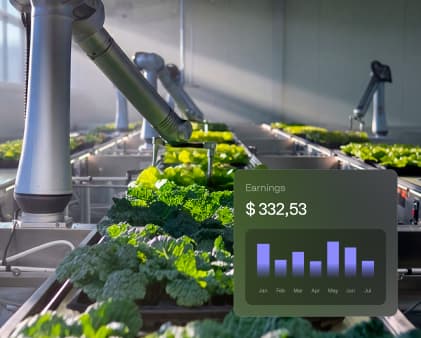
Revenue strengthens that profile further. Income from services, from data the robot has already generated, and from spare capacity such as unused compute can be metered through the peaqOS Monetize function and paid out to the operator, with each payment recorded against the machine that earned it. These are additional lines on the machine's record rather than the core of the case, but every verified unit of revenue a robot generates improves the picture a lender sees.
Getting there has to be simple for the operator. Doosan cobots run Dart-Suite, an app-based environment where functions are installed from the Dart Store much like apps on a phone. The intent is for peaqOS to reach customers through that same route rather than as a separate integration project.
“Physical AI is central to where we are taking this company, and it does not stop at better hardware or better models. We already build machines that sense their own work at every joint and are trusted on production floors in 45 countries. Our customers buy a robot for their busiest hour and pay for all the others. A robot at the cutting edge should be able to account for itself and earn in the hours nobody planned for, without handing over a single frame of what it saw. peaq gives us that capability, and we intend to put it in our customers' hands ahead of the market after successful testing.” — Michael Ryu, Head of Europe, Doosan Robotics
“A robot that can prove what it did is a different asset from one that cannot. Once the performance record holds up to outside scrutiny, the machine stops being a line of cost and becomes something a lender can actually assess. Doosan builds robots people already trust. We are making that trust legible to everyone else. This partnership has already sparked interest within our ecosystem of financing and deployment partners, and Doosan's leadership in Physical AI innovation underlines its position as a global collaborative robotics player.” — Martin El-Khouri, Chief Business Officer, peaq
The Roadmap
Phase One: First Doosan Robot on peaqOS
peaqOS has been installed on the first Doosan A-Series robot and has since been in testing.
The installation of peaqOS on the controller of a Doosan A-Series robot in peaq's Berlin office.
See the activated Doosan A0509 on the peaq machine explorer: machines.peaq.xyz/machine/59553499179785547240541790107334615076028120679642018345696955698709980164819
Phase Two: The Testing and Innovation Bed
The first Doosan robot running peaqOS is placed with a supervised student cohort at the Technical University of Munich, where teams build on the stack against a jointly defined challenge, culminating in a hackathon at the end of October.
Doosan Robotics runs its own certified operator and integrator training program and a global service partner network. The material developed with the Munich cohort is intended to feed that channel, so later adopters inherit a taught path rather than a research prototype.
Phase Three: More Robots Come Online
More robots are being activated in the coming months, moving the stack from a research floor onto machines already at work in commercial deployments and training centers.
Each activation adds the same three capabilities: identity, verified performance, and a financial record that lenders and insurers can assess machine by machine. This phase aims to position Doosan as the first cobot manufacturer able to offer this flexibility to its customers.
The point of scale here is evidence. A fleet with a track record is a fleet that can be financed.
Phase Four: The Robot as Its Own Collateral
The goal of this phase is machine-based financing across the Doosan range: a robot underwritten against what it demonstrably does and earns, standing as the collateral behind its own purchase, rather than against the balance sheet of whoever owns it.
peaq has established an ecosystem of financing partners and solutions compatible with peaqOS-equipped machines. The two teams are working on the first joint pilots. These pilots will draw on all of peaq's financing rails to cater to the individual financing needs of Doosan's customers, from Initial Machine Offerings (IMOs) for SMEs to the new product suite built around industrial deployments.
The First Robot Is Running
The first Doosan robot on peaqOS is live. More are being activated in the coming months.
Every one of them leaves a verifiable, auditable record of what it did and how well it performed, with the raw data staying inside the customer's cell.
Because a robot that can prove what it did is a different asset from one that cannot.
It should be financed like one.
→ Learn more about Doosan Robotics: https://www.doosanrobotics.com/en/


