
peaq Hosts Challenge at Europe's Largest Robotics Hackathon, Alongside NVIDIA, Universal Robots, NEURA and Doosan

Eight challenges. Eight challenge hosts. 80+ selected builders and six days at the Munich Urban Colab. peaq is hosting challenge #02 with Doosan Robotics and Codecflow.
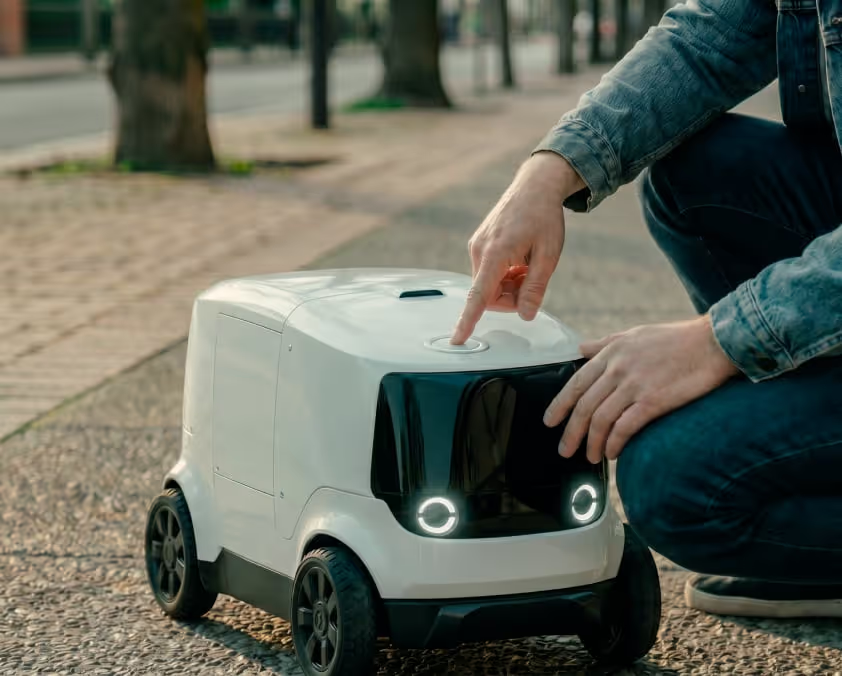
In October, a Doosan A0509 cobot in Munich will pick up a part, put it down, and issue a receipt nobody can forge.
Not a printout. A RobotWorkReceipt: a signed record of what the arm was authorized to do, what it actually did, and whether those two things match — checkable by someone who trusts neither the robot, nor the operator, nor the team that programmed it.
That is challenge #02 at the robo.innovate Hackathon 2026. peaq is hosting it with Doosan Robotics.
Eight Challenges, and the Companies Behind Them
peaq is one of eight challenge hosts at the fifth edition of the robo.innovate Hackathon, running October 23–28 at the Munich Urban Colab and the TUM MIRMI Geriatronics Campus. It is organized by robo.innovate at TUM's MIRMI institute with TUM Venture Labs Robotics / AI and UnternehmerTUM MakerSpace.
Read the roster. Universal Robots and Teradyne. NEURA Robotics. Doosan Robotics. NVIDIA. Durst and RobCo. SILOKING. Kyrall. Marmon. LiveKit. Codecflow.
Between them, these companies build the arms, the hands, the humanoids, the compute and the industrial platforms that physical AI actually runs on. Each challenge host puts hardware, mentors and engineers into the same rooms for six days, and the builders get to use all of it.
peaq is there for the one part none of them build. The money — and the proof that earns it.
Challenge #02: Policy-Governed Robot Autonomy
The brief is simple to say and hard to build. Write a robot work plan in simulation. Run it unchanged on a real Doosan A0509 cobot. Prove every step of it afterwards.
Using peaqOS, teams constrain the arm to authorized INSPECT, PICK and PLACE actions. Every action the robot proposes is checked against policy before the arm moves. When something is hidden, missing or has shifted, the robot has to fail safely rather than improvise. And the run ends in a RobotWorkReceipt an independent verifier can confirm without taking anyone's word for it.
Teams get the peaqOS SDK, Doosan hardware, a matching simulator in Codecflow's SimArena, and mentors from all three companies for the full six days. No prior blockchain experience required, which is exactly the point. If Robot Money only works for people who already understand crypto, it does not work.
The Part Nobody Else Brings
A robot that cannot prove what it did cannot be paid for what it did. That is the gap between a machine that automates a task and a machine that participates in the economy.
peaqOS closes it. Machine identity, embedded wallets on every supported chain, policy enforcement before the arm moves, telemetry-backed verification, settlement and permanent records — the full financial stack for robots and machines, omnichain from day one. More than 3,300,000 machines, robots, devices, vehicles and agents already carry verified identities on peaq, across more than 200 million transactions.
At the hackathon, that stack sits next to a UR cobot running an AI agent bridge, NEURA arms doing bimanual manipulation, and a GARMI robot holding a conversation. Same six days, same building. The arms move; peaqOS is what makes the work bankable.
Why Six Days on Real Hardware Beats a Press Release
Infrastructure does not win by announcement. It wins when engineers pick it up and use it on hardware they already trust.
The hackathon puts peaqOS in front of 80+ selected builders — people who program industrial arms for a living and have never had a reason to think about machine identity, machine wallets or onchain settlement. Six days later, some of them will have.
These places are competitive. In 2025, robo.innovate had far more applications than it had spots, and still landed a balanced mix of beginners and veterans. This year there are prizes worth €10,000+ and participation is free.
From the Munich Urban Colab to machine.fun
The best teams at an event like this do not stop at the demo.
The Financial Times has ranked UnternehmerTUM the leading start-up hub in Europe two years running. Start-ups from the TUM ecosystem raised more than €2 billion in private venture capital in 2024 alone, and 22 of them have reached unicorn status. robo.innovate itself supports 78 start-up teams and has seen €64 million in pre-seed and seed money collected since 2023.
That is the other reason peaq is in the room. machine.fun is where Machine Economy projects go from prototype to launch, and the teams worth backing rarely announce themselves in a pitch deck. They show up in a workshop at 2am with a robot that finally works. peaq and Codecflow will spend six days watching 80+ builders solve real problems on real hardware, and intend to spot the ones with a company in them early.
October 23–28, Munich
peaq, Doosan Robotics and Codecflow will be at the Munich Urban Colab with challenge #02, alongside NVIDIA, Universal Robots, NEURA Robotics and the rest of the challenge hosts.
Builders: applications and full challenge details are at roboinnovate.mirmi.tum.de.
Because a robot that can do the work should be able to prove it — and get paid for it. In October, in Munich, 80+ builders are going to make that happen on a factory arm.
→ Follow @peaq on X for updates from the floor.


