
Why peaq Is Backing machine.fun: Machine Money Markets Start With the Builder

peaq supports machine.fun with CodecFlow: a launchpad where robotics builders raise capital in public and show evidence for their machines with peaqOS.
machine.fun gives robotics and hardware builders a way to raise capital in the open. peaqOS shows the market which machines are running.
A small robotics team has a working prototype, a simulation anyone can run in a browser, and a public project page. Next to its token sits one line that says more than any pitch deck: three machines running peaqOS, online now.
That line is why peaq is supporting machine.fun.
machine.fun is a launchpad for robots, drones, physical AI, and DePINs, built with technology from CodecFlow and peaq. Builders raise capital in public. peaqOS shows the market which machines exist and run. And every builder who starts there is a future fleet running peaqOS, ready for the Machine Money Markets that come next.
What peaq Is Building
peaq is the omnichain Robot Money system. It gives robots and machines all they need to do business, on every chain.
Robot Money is anything robots and machines use to earn, pay, or hold value: stablecoins, tokens, x402 payments. Machines already create that value. A drone finishes a delivery route. A cobot runs a full shift. A sensor sells its data. What they have lacked is a way to own that value, prove it is theirs, and put it to work.
That is what peaqOS does. A machine that runs peaqOS gets an identity, its own wallets, a credit rating built from what it earns, and access to services and finance. It is omnichain by default. A machine on Base can buy a service on Solana, and vice versa, without anyone rebuilding anything.
The result is a new asset class. Robots and machines become identifiable, rated, verifiable, and financeable, and their owners share in what they earn.
The network behind it is already large: more than 3.3M robots, machines, devices, and vehicles onboarded, 200M+ transactions, and 60+ DePINs and Machine Economy apps across energy, mobility, connectivity, and AI. Doosan Robotics’ first cobot already runs peaqOS.
Most of that work finances machines that already exist. machine.fun is for the ones that don’t exist yet.
Every Hardware Builder Hits the Same Wall
A software founder can ship a product from a laptop over a weekend. A hardware founder needs money before there is anything to show: parts, tooling, a supplier willing to take a small order, testing, certification. Every step that is free in software costs real capital in hardware.
So the filter runs on access, not on quality. Founders with the right network get the meeting.
Founders without it get stuck at the idea stage. The best early allocations go to the largest investors, behind closed doors, long before anyone else can see them.
DePIN builders hit the same wall from the other side. They have a network design and a token model, but they need the first machines in the field to prove either one works.
The pattern is the same in both cases: good machines that never get built, and backers who never get a chance to fund them early.
peaqOS, at Its Core, Is a Way to Access Capital
peaqOS is often described by its parts: identity, wallets, credit, verification. But each part answers the same question that a lender, an investor, or a buyer asks: can I put money behind this machine?
The answers, one function at a time:
→ Activate. The machine gets a peaqID, omnichain wallets, and a Machine NFT. It now exists onchain
→ Qualify. A dynamic Machine Credit Rating, built from its revenue and activity history. It shows whether this machine makes money.
→ Verify. A genuine chip and a verified operator, anchored to the machine's identity. It shows whether this machine is real.
→ Stream and Monetize. Signed data and idle capacity become products the machine sells, paid to its own wallet.
→ Scale. The machine consumes services and Machine Money Markets through robotic.sh.
All six functions are live. Together they turn robots and machines into a new asset class: identifiable, rated, verifiable, and financeable. peaqOS gives machines, and the people who build them, access to capital.
That said, verification on machine.fun isn’t 100% bulletproof. At a startup’s early stage, operator verification doesn’t carry maximum weight. It is, nevertheless, strong evidence.
Machine Money Markets: Finance Apps for Robots
Once a machine can show that it is real and that it earns, money can flow to it. This is what peaq calls Machine Money Markets: finance apps for robots and machines that let them earn, trade, and borrow. It covers every market where machines are financed, owned, traded, or used as collateral.
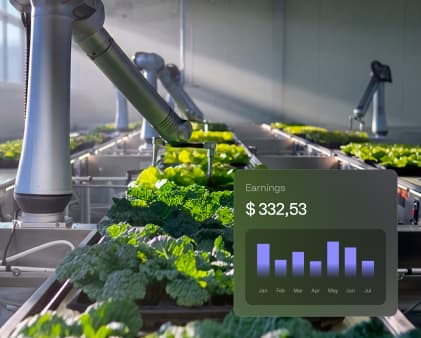
Some of these markets are already live. In Hong Kong, a vertical robo-farm grows lettuce, kale, and spinach and sells them to the local community. KanayaAI built and operates the farm, DualMint tokenized it, and peaq provides the infrastructure underneath. It became the world's first tokenized robo-farm: an Initial Machine Offering (IMO), where people buy tokens tied to a machine's real cash flows. Holders have received five-figure total payouts from a farm targeting a yield of around 20%. They earn from the vegetables.
The same model is growing across the peaqosystem:
→ XMAQUINA, incubated by peaq, is a $20M+ robotics investment DAO with direct positions in 1X, Figure AI, and Apptronik.
→ DualMint runs a marketplace for fractional ownership of revenue-generating machines: the RoboFarm, smart claw machines, and more. Every machine has a peaq ID.
→ Robot Money, an AI-managed treasury, puts idle machine earnings to work across machine assets and DeFi yield.
Each of these finances machines that already exist. Which leaves one question open.
The Missing Pillar: Capital for the Builder
An IMO finances a robo-farm that is already growing food. A credit rating needs revenue history. A lending market needs collateral. Machine Money Markets are strongest once machines are in the field and earning.
But every fleet starts as one prototype, and every prototype starts as one builder looking for money.
That is the second pillar of Machine Money Markets: capital for the builder, before the fleet exists. Money for the first unit, the first production run, the first deployment. Raised from anyone who believes in the machine, not only from whoever is already in the room.
That is what machine.fun is for, and it is why peaq supports it.
The two pillars connect directly. Builders raise on machine.fun to build their first machines. Those machines run peaqOS from day one. As the fleet grows, it graduates into the rest of Machine Money Markets: credit, tokenization, lending, and services. Serious hardware teams can also apply to the Foundry, a separate accelerator run by peaq and CodecFlow that takes builders from prototype to production.
How machine.fun Works
machine.fun is a permissionless launchpad on Solana, built on Raydium LaunchLab in collaboration with Raydium and Sunrise DeFi. It is designed for robots, drones, wearables, physical AI, DePINs, machine software, simulations, and the data that trains them.
A Project First, a Token When Ready
Every project starts as a public page: what the machine is, who is building it, and what has been proven. A name is enough to begin. Many teams will build an audience for months before they launch a token, and some never will.
When a team is ready, the launch takes one signature. Creating the token and the founder's own first buy happen in the same transaction, so the founder commits to a position before anyone knows how the launch will go. Once a token is live, the project page and the account behind it are permanent. Your name stays attached to your launch.
Builders Earn From Trading, Not Just Selling
Every trade on a machine.fun token pays a fee, and a share of it flows straight to the project's own vault. Builders claim it as it accrues. Trading volume becomes operating income, so founders don't have to sell their own tokens to keep building.
A share of platform revenue goes to buying $PEAQ on the open market. Those tokens are not handed out as rewards: they help fund peaqOS onboarding for selected projects, so teams can bring their machines online when their capital is tightest. The exact percentage of token buybacks will be released at a later stage.
Ignition: Founder Selling, Made Public
Every founder eventually needs to sell some tokens. Building costs money. What hurts a market is not the selling itself, but not knowing how much supply is out there or when it will arrive.
Ignition is machine.fun's answer. At launch, a founder can lock part of their initial buy into sell orders placed at price levels above the launch price. Nothing can sell at or below the price everyone else paid. As the price rises through those levels, buyers take the tokens and the proceeds come out under a daily limit. The commitment is optional and permanent. There is no admin key, and nobody can change or unlock it later.
The founder gets funding that arrives as the project works. Backers get a published fact instead of a hidden risk.
CodecFlow: Evidence Before Hardware
CodecFlow builds SimArena, a browser-native robot simulator. It needs no install and no GPU, and it is open source. Builders can drop a robot into a scene, teleoperate it, record episodes, and export training datasets. The same robot definition can later run on physical hardware.
On machine.fun, a simulation is often the earliest evidence a project can show: a robot, a task, and a policy that performs it, which anyone can open and run. When the hardware arrives, peaqOS takes over.
peaqOS: The Information Layer Behind Every Machine
Anyone can write anything in a project description. Simulations show that a machine could work. peaqOS shows evidence that a machine exists and is running.
Here is how it works. A builder onboards a machine to peaqOS, which gives it a peaqID. On machine.fun, they link that machine to their project by signing a challenge with the machine's own key. The badge means the machine's own credentials answered, not that someone typed in an ID.
Once linked, the project page shows live data read from peaq:
→ How many machines the project has onboarded and linked.
→ Whether each one is online right now. If the heartbeat can't be reached, the page says "unknown" rather than showing a working machine as dead.
→ Its rating and whether it’s bonded, as defined by peaqOS.
→ Its event history. History stays on the page even if the owner stops publishing new events.
For a trader, this changes what can be checked. "We have a fleet" becomes a number of machines. "It works" becomes a live status. A project that has linked nothing is telling you something too.
A Signal, Not a Guarantee
We want to be precise about what this proves.
A peaq badge proves that a machine with a peaq identity exists, that a project admin controls its key, and what status that machine reports. It does not prove that the machine does what the project claims, that it is the machine in the photos, or that it can't be compromised, spoofed, or faked. Machines that also pass peaqOS Verify carry chip-level evidence in their record, which raises the bar. It is still evidence, not a promise. Only the combination of operator verification and peaqOS verify give the highest level of conviction.
And one online machine proves a prototype, not a product. The gap between the two is where most hardware companies struggle.
So peaqOS on machine.fun is not a seal of approval. It is a signal: a shorter list of things a founder could be making up, and real data attached to every claim that remains. What a trader does with it is their call.
Why This Matters for peaq: Fleets That Start With peaqOS
Here is the strategic bet.
A builder who uses peaqOS on machine.fun to raise their first round does not stop at one machine. If the project works, they build ten, then a hundred, then a fleet. Every one of those machines is a natural candidate to run peaqOS, because the first one did.
And the more mature a project gets, the stronger the reasons to onboard every machine:
→ Confidence. A growing, live machine count is the clearest evidence a builder can show their community. Projects with something real to show will want to show it.
→ Capital. This is the bigger reason. A fleet running peaqOS builds a Machine Credit Rating from real revenue. It can be verified, tokenized through an IMO, financed by lenders, and connected to services through robotic.sh. Every other Machine Money Market peaq brings onboard becomes open to it.
That is the flywheel. Builders raise on machine.fun, they onboard machines to peaqOS from day one, their fleets grow, and each new machine gets access to more capital than the last. The peaqOS machine count grows with every successful project, because adoption comes from builders who need it, not from a campaign.
For the $PEAQ community, the link is direct. Under peaq Economics 2.0, machines that activate trust-tier services bond $PEAQ, which locks it out of circulation for as long as they take part. More machines running peaqOS means more bonded $PEAQ. On top of that, a share of machine.fun's platform revenue buys $PEAQ on the open market.
machine.fun is where many of tomorrow's peaqOS fleets begin.
The First Machine Is the Hardest to Fund
Machine Money Markets already finance robots that grow food and pay their owners. What was missing was the step before: getting the first machine built at all.
machine.fun covers that step. CodecFlow brings the simulation evidence. Raydium and Sunrise DeFi bring the launch rails. peaq brings peaqOS, the layer that shows which machines are real and running, and that carries them into the Machine Economy as they grow.
If you are building a robot, a drone, a DePIN, or anything physical AI, you no longer need an introduction to raise your first round. You need a machine worth backing, and the willingness to prove it in public.
→ Launch your project on machine.fun. Onboard your machines to peaqOS from day one, and let your fleet grow into the full Machine Money Market stack.


Explore more

peaq Lets Robots and Machines Talk to Buildings with KETI's Mobius

peaq and EintrachtTech Partner to bring Machine Economy Opportunities to Stadium Environments
