
peaqOS and World ID enable Proof of Human for Robots and Machines

World ID, the anonymous proof of human, is now on robotic.sh. With peaqOS, a robot or machine can check that the person in front of it is a real human, and the same one who placed the order. It doesn’t need any private data for that. Autonomously, on demand, without human intervention.
World ID, the anonymous proof of human, is now available to robots and machines running peaqOS. A machine can check that the person in front of it is a real human, and the same one who placed the order. It never learns a name, a face, or a number. And every check runs natively within peaqOS, free of charge. Autonomously, on demand, without human intervention. Available now on robotic.sh.
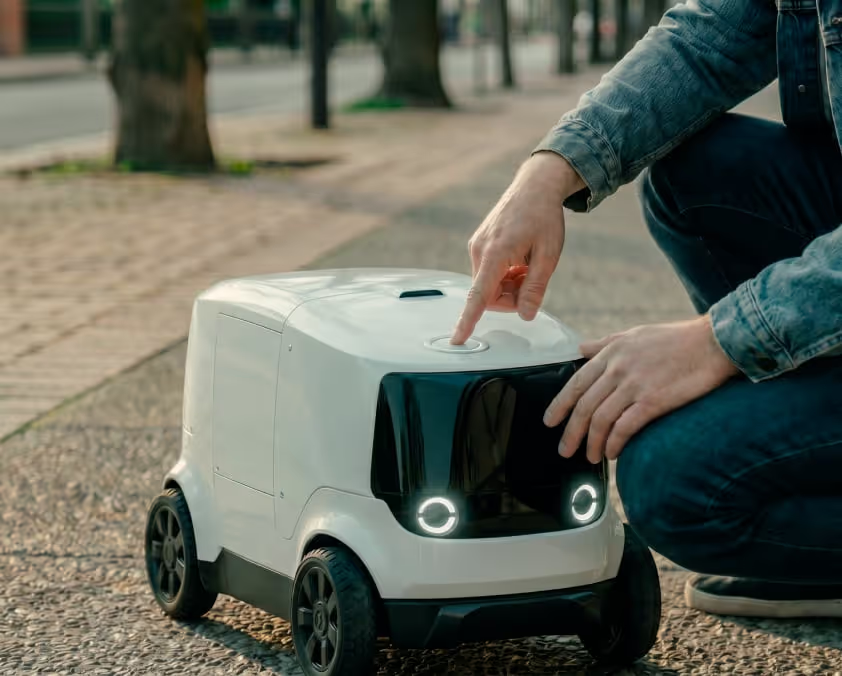
A delivery robot pulls up to a doorstep in Seoul with medication in its sealed compartment. Someone steps out and reaches for the hatch. The robot's cameras see a person. What they cannot see is whether it's the right person, or a person at all behind the order.
It has two options. Open for whoever reaches first, and trust that PINs don't get shared, phones don't get taken, and orders come from humans, not scripts. Or push the problem back to people, an ID check, a signature, a human courier, and give up the autonomy it was built for.
With World ID via peaqOS, there's a third option: the person scans once and proves two things, they're a real human, and they're the one who ordered. The robot verifies and opens. It never learns who they are. It doesn't need to.
What World ID Unlocks on robotic.sh
World ID is proof of human for the age of Physical AI: a way for a person to prove they're a real, unique human, anonymously, using a zero-knowledge proof from their World App. Nearly 18 million humans have verified at an Orb, across a network spanning 160 countries. The proof carries no name and no biometrics, just the answer to the only question that matters: real, unique, and consenting.
That's the differentiator. A camera can see a face. It can't tell whether that face is real, unique, or the one that placed the order. Every old fix either collects identity or trusts a code anyone can pass along. World ID answers without collecting anything.
Starting now, that answer is available through robotic.sh. A robot or machine running peaqOS can request a proof-of-personhood check and verify it natively through peaqOS. No account, no API key, free to verify. The person scans, the proof arrives, the machine knows.
It's the first integration of its kind: proof of human, native to the Machine Economy. And it's live on robotic.sh today.
Why This Matters: The Right Human, Nothing Else
The internet is filling with agents and bots, and robots are walking into the physical version of that problem. A machine that hands over goods, unlocks doors, or takes commands needs a real human on the other side. Often a specific one.
Every old answer costs something. PINs and pickup codes can be shared, stolen, or guessed. Identity checks work, but now a delivery robot is photographing ID cards, and a fleet is warehousing exactly the data it never wanted to hold.
Proof of human removes the trade-off. The machine gets certainty, the person keeps their identity, and nothing sensitive is created in between. The person verifies at the order and again at the door. Same human, confirmed. The record shows only that a verification happened, metadata redacted.
peaq Handles the Coordination
peaq is the layer that lets machines reach World ID and use it. For each verification, peaq handles:
- Machine identity, via peaq DIDs
- Discovery of the service on the Machine Market
- Coordination of the verification, from request to result
- A verifiable, auditable record of what ran, with the proof metadata redacted
So a machine can know it's serving a real human, without collecting a single thing about them.
Showcase: A Medication Handoff, Verified Three Times, Zero Identities Revealed
We're showcasing the integration with a demo where a delivery robot in Seoul carries medication from a pharmacy to a patient, with World ID verifying every human in the chain. peaqOS handles identity, discovery, and the record; World ID proves the humans; nobody's name enters the system at any point.
Here's the scenario: a patient orders medication for home delivery, and the robot needs to be certain twice: real human behind the order, same human at the door. Here's how the process unravels:
→ The robot checks in under its own peaqOS identity and asks the Machine Market for a proof-of-personhood service; peaqOS resolves World ID, native execution, nothing to pay per order
→ The patient verifies through World App before the order is accepted; the robot receives a zero-knowledge proof, not a name
→ At the pharmacy, the pharmacist verifies before the medication is loaded, and the compartment seals
→ At the doorstep, the patient scans the code on the robot and verifies again: same human as the order, and the compartment unlocks
→ The handoff is recorded, order completed, proof metadata redacted
Three verifications, one delivery, zero identities revealed. The robot knows exactly as much as it needs to: real human, right human, every time.
More Real-World Scenarios
Scenario 1 — One Per Human, Enforced by a Robot
A promo robot works a shopping district, handing out samples, one per person. By noon, the old version of this story is a cleaned-out robot: the same hands coming back, and scripts placing pickup orders faster than humans can walk.
The old way is a staff member standing next to an autonomous machine, watching faces.
Instead, each person verifies with World ID before the hatch opens. The proof says real, unique human, and unique means once: the same person can't come back as somebody new, and a bot can't come at all.
Fair by design, enforced by the machine itself.
Scenario 2 — A Rental Robot That Needs No Account
A shared robot, a scooter, a delivery cart, a porter, stands in a lobby, and a stranger wants to use it. Today that means an app, a sign-up, a card on file, and a company holding one more profile of one more person.
The old way trades ten minutes of onboarding for a permanent copy of your identity.
Instead, the person proves they're a real, unique human, and the machine unlocks. One human, one session, on the record, and the operator's database of personal data simply never comes to exist.
Access for anyone real. Records about no one.
Available Now on robotic.sh
World ID proof of human is now live on robotic.sh for robots and machines running peaqOS.
Machines can verify a real, unique human at any point of contact, free of charge. Every verification leaves a verifiable, auditable record, with the proof metadata redacted.
Because autonomous machines shouldn't have to choose between trusting anyone and identifying everyone.
They should know they're serving a real human, and nothing more.
→ Visit robotic.sh to get started.


