

peaq and Akash Network Unlock Autonomous Elastic Compute for Robots and Machines

peaq and Akash Network are officially partnering to bring decentralized elastic compute to robots and machines running peaqOS — so they can scale their intelligence autonomously, on demand, without human intervention. Available now on robotic.sh.
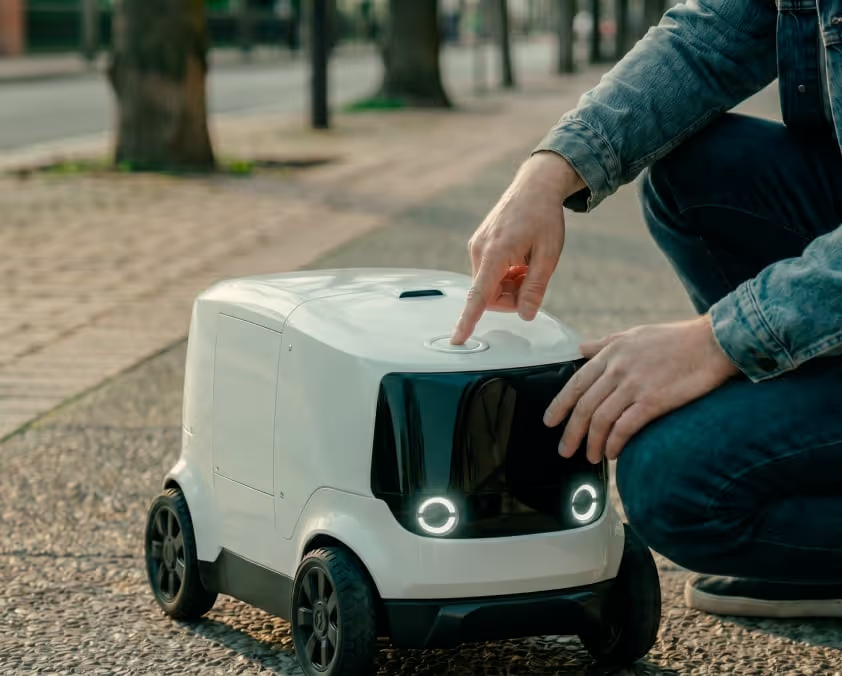
A delivery robot is navigating a city at rush hour. Traffic is dense. Routing is suddenly complex. Pedestrians everywhere. The delivery window is shrinking.
The robot's onboard compute hits its ceiling.
In the old world, that robot either slows down to squeeze more juice out of its hardware (and hopefully doesn’t crash), or calls home to centralized cloud infrastructure that introduces new dependencies and new failure points.
In the new world, it requests compute on demand, gets it in seconds, adapts, and continues.
That new world is here.
What peaq and Akash Network Are Building Together
peaq and Akash Network are officially partnering to bring decentralized compute to robots and machines running peaqOS.
Starting now, compute on Akash Network is available through robotic.sh, allowing any robot or machine running peaqOS to dynamically access external GPU and CPU resources whenever local hardware isn't enough.
This is the first integration of its kind. Machines with elastic compute. Not a roadmap item. Not a pilot. Available now.
"Until today, every robot in the world ran into the same wall: its own onboard compute. Now, any machine running peaqOS can reach into Akash Network the moment it needs more, no matter what chain it’s on, and pay for it autonomously. Elastic compute for machines isn't a roadmap item anymore. It's live."
— Till Wendler, peaq’s co-founder
"Akash was built so that anyone — or anything — can access compute without permission, without lock-in, and without centralized gatekeepers. Extending that to autonomous machines on any chains through peaq is the natural next step, which connects Akash with millions of new prospective users. Robots and AI agents are about to become some of the largest consumers of compute on earth, and they deserve an open network underneath them."
— Greg Osuri, Founder of Akash
Why This Matters: The Compute Problem Machines Have Always Had
Most robots and machines rely only on onboard hardware for compute. That's a hard constraint. You either oversize the hardware for peak workloads — paying for capacity you barely use — or you design around the limits of onboard compute and accept worse performance.
Neither answer is good enough for machines operating autonomously in the real world.
Decentralized elastic compute changes the equation. When a machine encounters a workload too demanding to process locally — AI inference, computer vision, simulation, mapping, large-scale planning — peaqOS packages that workload into a standardized compute request and routes it for execution through Akash Network.
The result returns directly to the machine. The machine continues operating.
No manual provisioning. No oversized hardware. No dependency on centralized infrastructure.
peaq Handles the Coordination
Behind the scenes, peaq coordinates the full Machine Economy layer around every compute request:
- Machine identity verification
- Trusted execution coordination
- Provider reputation
- Payment settlement
- Verifiable receipts
Machines remain autonomous. Their capabilities simply scale with demand.
Showcase: Unitree G1 Humanoid in NVIDIA Isaac Sim
We’re showcasing the strategic integration with a demo involving a Unitree G1 humanoid tapping Akash to tweak its local models for motorics tasks. The simulation was run in NVIDIA’s Isaac virtual environment, with peaqOS orchestrating the process and firing off live transactions.
Here’s the scenario: The Unitree humanoid’s been working at a warehouse all day. As part of that, it’s done countless grasping tasks, with some of those failing. Now, as its shift ends, is the time to leverage the data accumulated during the live operations to fine-tune its models and optimize its locomotive functions for the next shift.
There’s a catch, though. The robot’s local hardware only does inference locally, handling the robot’s immediate operations. So it taps Akash for the actual training via peaqOS, leveraging its paired AI agent. Here’s how the process unravels:
→ peaqOS packages the robot’s needs into a standardized compute request and submits it to Akash Network via robotic.sh
→ Akash returns provider bids and assigns the workload to the selected provider via a lease
→ The provider runs the workload and returns the updated model artifact
→ peaqOS routes the result back to the robot, with payment settled through the operator's Akash account
You can find the transaction involved at this link on Mintscan.
More Real-World Scenarios
Scenario 1 — A Delivery Robot Gets Extra Compute During Rush Hour
A delivery robot operates independently throughout a city. Most of the day, its onboard compute is sufficient.
But during peak traffic, navigation becomes significantly more complex: dynamic routing, dense pedestrian movement, changing delivery priorities, environmental understanding, all hitting at once.
Instead of slowing down or carrying expensive idle hardware permanently, the robot requests additional compute capacity through robotic.sh. The workload executes through Akash Network. Seconds later, optimized routing and environmental predictions return directly to the robot.
The robot adapts and continues. Compute only when needed.
Scenario 2 — A Humanoid Technician Runs Remote Simulation Before Acting
A humanoid maintenance robot is deployed at an industrial facility. During inspection it encounters an unexpected equipment anomaly.
Rather than executing immediately, the robot generates several repair scenarios and runs remote simulation and evaluation through Akash compute accessed via robotic.sh. The simulation returns recommended actions and confidence levels.
The robot selects the best path and executes autonomously. Instead of permanently carrying workstation-grade hardware, intelligence expands dynamically.
Available Now on robotic.sh
Compute via Akash Network is now live on robotic.sh for robots and machines running peaqOS.
Machines can discover services, consume compute, access external capabilities, and expand what they can do — dynamically and on demand.
Because autonomous machines should not be limited by the hardware they carry.
They should grow with demand.
→ Visit robotic.sh to get started.


