


Why Robots Don't Deploy At Scale | Unusual Assets Need Unusual Financing

This is the second part of the essay by peaq’s CBO Martin El-Khouri; read the first part here.
Let’s quickly recap: Capital wants exposure to robotics-as-an-asset-class. Robots are generating verifiable revenue. The rails between the two are running on paperwork and underwriting models built for static industrial equipment held on creditworthy balance sheets. Three of those four conditions are no longer the world we're living in.
Here's where the analysis usually stops. Most commentary identifies the financing gap and reaches for the obvious solution: better RaaS, more vendor financing, larger balance sheets at the OEMs. None of that scales. Vendor balance sheets are finite. RaaS is harder than SaaS because the vendor takes physical, financial, and operational risk simultaneously. And every additional dollar of vendor-financed deployment is a dollar that compounds the maker's burn problem we started with.
The financing gap doesn't close by stretching old rails further. It closes by recognizing that a productive machine is a fundamentally different asset than a forklift, and pricing it accordingly.
The unique property is data.
A Machine Isn't Equipment. It's a Revenue Stream With a Sensor Stack.
Every robot deployed in production generates a continuous, cryptographically loggable stream of operational telemetry: hours run, tasks completed, error rates, environmental conditions, energy consumption, maintenance events, the data its sensors produce, the work product it delivers. As Columbia's Laura Veldkamp has documented, data is an economic asset that doesn't deplete or wear out, and can be used across unlimited use cases at near-zero marginal cost. A 2024 Korean study on data valuation models for collateral lending describes this as a fundamental shift in what counts as an underwritable asset on a corporate balance sheet.
This isn't theoretical. The most consequential precedent in modern corporate finance for the data-as-collateral thesis is the COVID-era airline rescue. In 2020, American Airlines pledged its AAdvantage frequent-flyer program as a first-priority security interest — co-branded credit-card agreements, member relationships, partner participation rights, and crucially, the underlying loyalty data and IP — to secure a $5.5 billion CARES Act loan. The third-party appraisal valued AAdvantage at $19.5 billion to $31.5 billion, versus an airline market cap of less than $7 billion at the time. A Stifel analyst said the loyalty program was the only reason American wasn't in bankruptcy.
American eventually used the loyalty program to raise $10 billion in private senior secured notes, repaid the government loan in full, and freed itself. United, Spirit, and Delta executed similar structures with MileagePlus and SkyMiles. Across the industry, customer-relationship data was pledged as collateral for tens of billions of dollars of debt — at terms no airline could have raised against its hard assets alone.
The lesson is clean. When the underlying business generates verifiable, recurring cashflows that can be tied to a discrete data asset, capital markets will underwrite the data, not the machine that produced it. AAdvantage worked because every flight a member took produced auditable points-and-miles activity that flowed through structured contractual rails. The collateral wasn't the planes. It was the data layer the planes generated.
Here’s What a Productive Robot Fleet Looks Like
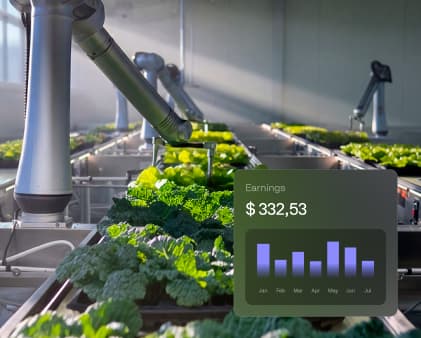
A robotaxi earning $500/day produces a continuous stream of: route data, occupancy data, operational uptime, maintenance telemetry, energy consumption, payment receipts, and proof-of-service for each ride completed. A picking robot at a warehouse produces task-level throughput, error rates, item-handling data, and verifiable per-shift output. A robotic farm produces yield data, environmental telemetry, water and nutrient consumption, harvest quality. A stadium-grade camera produces crowd analytics, broadcast feeds, B2B licensing logs, fan engagement metrics.
Each of those data streams is — or can be — a monetizable revenue stream in its own right, generating auditable cashflow that can service debt, secure collateral, or be sold directly into a market. The machine isn't just earning by doing the physical work. It's earning by producing the data the physical work generates.
Tesla is the most-studied example because it's the largest fleet operating at scale. Tesla's FSD fleet has now logged over 10 billion supervised miles, with approximately 50 billion miles per year of real-world driving data being captured across more than 5 million vehicles. RBC analysts project this data flywheel could generate $53 billion in annual revenue by 2035 through FSD subscriptions and licensing — entirely separate from vehicle sales. McKinsey has projected the broader "car data market" at up to $750B by 2030.
The monetization paths are concrete and already operating. Tesla uses live vehicle telemetry to price its own insurance products — converting the same data the cars generate while driving into actuarially priced premium income. In January 2026, Lemonade launched autonomous-car insurance with 50% per-mile rate cuts for FSD-engaged Tesla drivers in Arizona and Oregon, priced directly off Tesla's Fleet API. Without mile-level telemetry distinguishing FSD-on from FSD-off driving, that actuarial model is impossible to build. With it, Lemonade can underwrite a multi-billion-dollar insurance line off another company's fleet data.
Tesla isn't unique in the principle, only in the scale at which it's currently executing. Every productive machine, in every category, generates the same kinds of data. What's missing isn't the data. It's the infrastructure that turns the data into a verifiable, attributable, financeable asset — the way AAdvantage's contractual rails turned millions of disconnected member transactions into $10 billion of underwritable collateral.
What That Infrastructure Has to Do
If you take the AAdvantage precedent seriously and apply it to a robot fleet, you can specify what the missing infrastructure has to do. Capital markets need three things to underwrite a productive machine the way they underwrote AAdvantage:
- Verifiable identity — every machine has to be uniquely, persistently identifiable across operators, owners, and jurisdictions, so its output can be tied to the underlying asset rather than to whoever happens to be holding it this quarter.
- Cryptographic credit history — operational telemetry, revenue, maintenance, uptime, and task-level performance have to be logged in a form a third party can audit without trusting the operator. The point of cryptographic logging isn't decentralization for its own sake. It's that no underwriter, insurer, or lender will price an asset off self-reported data from the entity that owns it.
- Ownership structure capital can trade — fractional or whole-fleet positions need to be tradeable, securitizable, and pledgeable in formats institutional capital understands and regulators have a framework for, the way AAdvantage was wrapped through a Cayman SPV that could issue senior secured notes into bond markets.
None of this is exotic. It's exactly the structure capital markets already use for any other revenue-generating asset class — receivables, royalties, mortgages, loyalty programs, IP. The machine economy needs the same primitives applied to physical machines that earn.
When that infrastructure exists, the financing gap collapses from multiple directions simultaneously. The S&P 500 buyer no longer has to put a humanoid fleet on its balance sheet — it can lease against the fleet's earnings, with the data as the collateral the lessor underwrites. The mid-market manufacturer no longer needs personal credit; the cobot's verified output is the credit. The SME that can't clear a bank's bar can pledge the machine's revenue stream to a yield-bearing capital pool that prices risk off live telemetry, not legacy financial statements. The stadium operator's cameras pay for themselves out of the data they produce — financed against the streams they're already generating, not the operator's balance sheet. As Columbia's data-asset valuation work argues, the inclusion of data assets in corporate balance sheets is likely to increase enterprise value significantly — but only when the valuation framework is rigorous enough that capital can actually underwrite against it.
This is the part of the argument that's easy to underestimate. Once a machine has a persistent identity and a cryptographic record of its earnings, the longer it operates, the better its financing terms get. Uptime data lowers the cost of capital. Verified throughput unlocks larger credit lines. A track record across multiple deployments tightens spreads on the next deal. The asset improves its own credit profile through operation. That's a property no piece of static industrial equipment ever had.
What This Means for the Next 24 Months
The companies that come through 2026–2027 will look different from the ones that don't, in three specific ways.
First, they'll stop trying to substitute venture equity for capital that should come from debt or asset-backed structures. K-Scale Labs didn't fail because the technology didn't work. It failed because every dollar of prototype manufacturing came out of dilutive rounds that priced the company like SaaS. Robotics burn rates are 3–5x SaaS burn at equivalent revenue, and SaaS investors keep underwriting them like SaaS. The survivors will run dual capital stacks — equity for the parts of the business that genuinely require equity-like risk-taking, and asset-backed instruments for everything that touches productive hardware.
Second, they'll stop pretending RaaS is just SaaS with metal. RaaS works as a customer-acquisition wedge but breaks as a long-term financing model the moment fleet capex outruns vendor balance-sheet capacity. The vendors who scale will partner with — or actively co-design — capital structures that move the residual risk off their balance sheet and onto pools designed to underwrite it. That includes asset-backed lending against verified fleet earnings, fractional ownership structures for long-tail assets, and yield-bearing instruments backed by live operational data rather than promises. Morgan Stanley's industrials desk has been telegraphing this for two quarters running: the technology is no longer the biggest uncertainty. The business model is.
Third, they'll treat machine identity, telemetry, credit history, and tradable ownership structure as substrate — not as differentiation, not as a moat, not as features. The SaaS generation didn't try to build their own AWS. They plugged into it. Robot makers, fleet operators, financiers, insurers, and customers in 2026–2027 should be doing the same thing with the financial infrastructure for productive machines. Every company that tries to build it themselves is spending burn that should be going into the wedge that's actually theirs to win — the physical work, the customer relationships, the proprietary embodied intelligence.
This is the structural answer to the financing gap section 1 described. The S&P 500 buyer can't afford the capex line. The mid-market manufacturer can't afford the debt. The SME can't clear the bank's underwriting bar. The non-industrial buyer doesn't fit the template. Every one of those failures has the same root cause — capital can't see the asset. The same primitive solves all four cases: a cryptographically verified, identity-bound, audit-grade record of what each machine is producing, packaged in structures capital markets already know how to price.
The Honest Conclusion
Robotics is not failing. Industrial robot installations hit $16.7B in 2026, an all-time high. Roughly 4.6M robots are operating in factories worldwide. The category works.
What's failing is the new generation of general-purpose, AI-driven, humanoid and mobile-manipulator companies trying to build the next layer on top of that base. Their failure mode is rarely "the robot didn't work." It's almost always "the company couldn't survive long enough to make the robot work in production at unit economics that close." And that, in turn, is almost always a financing problem dressed up as a technology problem.
The robots arrived. The capital is arriving. The rails between them are the missing piece, and they look much more like AAdvantage in 2020 than like a Mitsubishi UFJ equipment lease.
The companies — and the chains, and the operators, and the buyers — who figure that out in the next 18 months will still be here in 2028.
The ones who don't are already writing the farewell letter. They just don't know it yet.


