
peaq onboards German SMEs to the Machine Economy

peaq, Strategy Alliance, and idOS team up to unlock self-sovereign machine IDs and tokenization for German enterprises. peaq joins the partnership as the implementation layer, its stack also unlocking native integrations with agentic AI, onchain reputation scores, and rule-based access control.
Germany runs on SMEs. Small and medium-sized enterprises account for more than half of the country’s GDP and employ the majority of its workforce. That’s thousands of highly specialized businesses with decades of embedded industrial know-how. And most of these businesses heavily rely on advanced machine-powered capabilities: precision manufacturing lines operating around the clock, smart energy system and agritech hardware, logistical fleets
This partnership paves the way for them to become onchain financial assets.
Bringing the Machine Economy to Germany
peaq, Strategy Alliance, and idOS are joining forces to connect Germany’s industrial capacity directly to the Machine Economy through live production deployments. Strategy Alliance is a major German consulting company providing bespoke AI solutions for clients such as Altana (global specialty chemicals), Haniel (diversified family equity holding), and Werhahn Gruppe (industrial conglomerate spanning building materials, consumer goods, and financial services). idOS is an identity platform for the stablecoin economy. The goal of the partnership is simple: to enable hundreds of German businesses to onboard their machines to peaq, tokenize them, and unlock compliant liquidity to grow their operations.
Because when machines can own wallets, transact, and prove identity, they turn into full-fledged economic agents, which promises a whole new world of opportunity to Germany’s industrial backbone.
A Shortcut to Industry 4.0
Industrial companies face a familiar constraint: machines are expensive to buy, slow to finance, and illiquid once deployed. A robot on a factory floor might generate revenue for 10 years — yet its value is locked inside a balance sheet. But peaq changes that.
On peaq, every onboarded machine receives:
- A decentralized identity, which enables them to interact with apps, people, and other machines and serves as the provenance proof for data and services created by the machine. For enterprises, this means easy access to peaq’s ecosystem of 60+ real-world apps, including smart energy grids (Combinder), AI agents (Teneo Protocol), AI training data collection platforms (Silecio), and more.
- Its own wallet, which enables it to transact autonomously. This unlocks native machine-to-machine payments, enabling machines to pay for their own maintenance and earn by selling services on Machine Economy marketplaces.
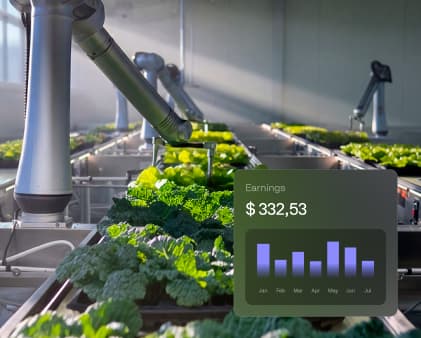
- Tokenization capacity, meaning any machine can be fractionalized and turned into liquid onchain tokens. The world’s first tokenized robo-farm is already live on peaq, and is about to cross the $10,000 rewards distributed milestone, and peaq’s technological stack brings its underlying business model to the German SME space, enabling companies to turn their active manufacturing capacities into tradeable onchain assets and raise liquidity by offering to the global investor community.
- Its own onchain reputation score, immutable and transparent due to the blockchain’s open nature. The reputation scores on peaq will work as a clear and accessible way to pick the optimal counter-party in any business venture, whether it’s procuring data from sensor arrays or buying energy from decentralized grids; either way, the buyer would be able to verify the supplier’s track record onchain.
- Native agentic AI integration, thanks to peaq’s recent integration with OpenClaw. By installing peaqOS, the universal machine Economy operating system, through OpenClaw, German companies will be able to outfit their machines with ready-made, reusable skills that will transform hardware into intelligent economic agents.
- Role-based access rules, which enable enterprises to set trustless protocols for using their machine fleets. The German SMEs will be able to set the terms on which the counterparties will be able to leverage their capacities, executed with the baked-in security of a blockchain protocol.
For the German SMEs, all this unlocks a world of new possibilities, starting from liquidity that doesn’t come with selling equity and culminating in an entire programmable network-economy running on a vendor-neutral backbone. It enables them to turn their existing capacities into liquidity-generating assets without taking on extra risks or otherwise adding overhead while also greatly expanding their autonomy and agentic potential. In essence, the partnership delivers an end-to-end shortcut into Industry 4.0, AI-imbued and powered by machine intelligence, all wrapped into a single installation of peaqOS.
Each Partner’s Role
This partnership is designed for real-world deployment, with each party covering a critical layer of the stack.
peaq — the coordination layer
peaq provides the base infrastructure for the Machine Economy.
Every asset receives a peaq ID and connects directly to the the peaq Layer-1 blockchain. On peaq, machines can:
• settle payments
• share data
• access real-world apps and Web3 services
• and tokenize their output or ownership
With 3M+ of devices already connected, peaq serves as the programmable backbone that lets industrial hardware operate as digital economic agents.
idOS — the human layer
Machines don’t operate alone. Companies, operators, and regulators still matter.
idOS adds self-sovereign identity and verifiable credentials so that:
• businesses stay compliant
• audits are simpler
• KYC/KYB travels with the entity
• and reporting works across jurisdictions
Identity where regulation requires it. Privacy everywhere else.
Strategy Alliance — the implementation layer
Strategy Alliance brings deep integration expertise across German industry, already working with enterprises such as Altana AG, Forsa, and Zwilling J. A. Henckels.
They embed peaq and idOS directly into operational environments — factories, fleets, and production systems — ensuring that onboarding happens in live workflows, not sandbox demos.
Not a Pilot. Infrastructure.
Machine-to-machine payments are already live on peaq. The coordination layer exists. What’s happening now is the next step: bringing that infrastructure into the companies that already run the real economy. This partnership delivers exactly that.
The Machine Economy isn’t theoretical anymore, we’ve already showcased that with the launch of the world’s first tokenized robo-farm. Germany’s industrial base is uniquely positioned to lead this shift. It already has the machines. It already has the expertise. And now, it has the onchain rails as well.
Join the Machine Economy
As German SMEs are about to dive into the new era, so can you. Earn from tokenized robots, use Machine DeFi, and help keep peaq secure and decentralized by staking; all that and more is already live on the peaq app, your portal into the Machine Economy.
Sign up now and get ahead of the game.


